

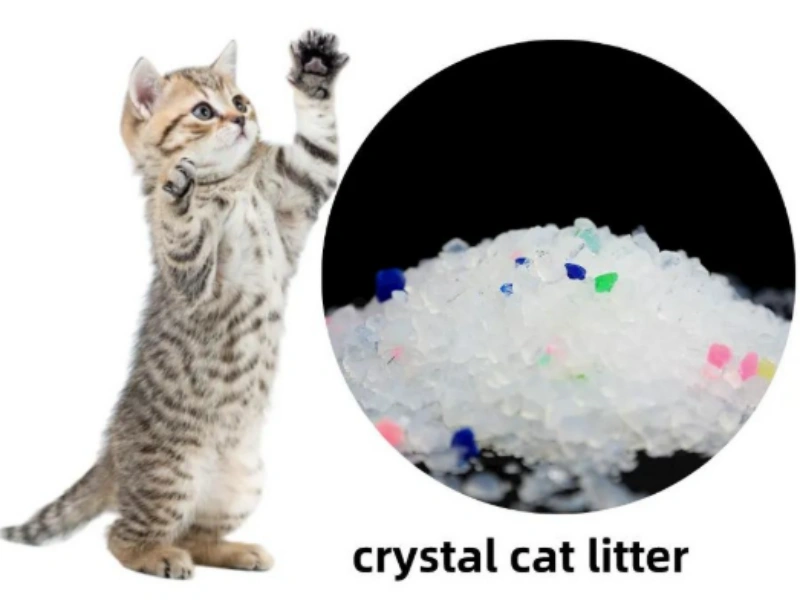
What Is a Crystal Cat Litter Production Line?
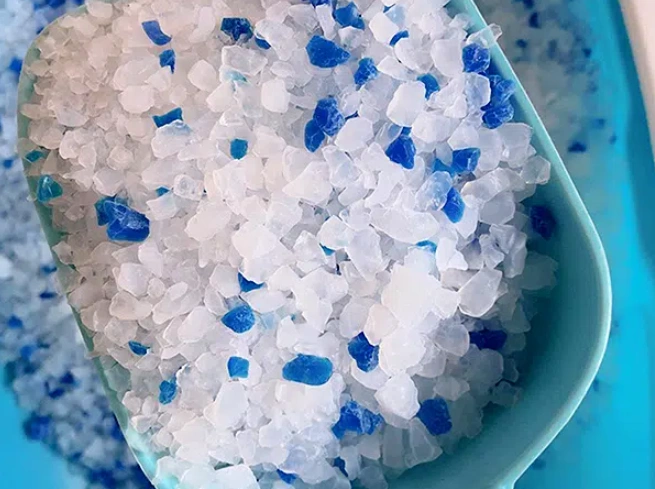
Crystal cat litter(also known as silica gel cat litter) is a type of cat litter commonly made from silica gel. Its crystal-like particles are designed to absorb and retain liquid, making it different from clay-based, plant-based, paper, and wood cat litter. Because the raw material and particle characteristics are different, its production process also requires equipment selected according to the material condition and final product requirements.
A crystal cat litter production line is not simply one machine. It is a combination of equipment used to handle, screen, dry, convey, and package the raw material and finished product. The exact configuration can vary according to the raw material, production capacity, particle size, moisture requirements, and packaging specifications.
For commercial production, the process usually focuses on preparing the silica gel material, removing impurities and irregular particles, controlling particle size, managing moisture, and finally packaging the finished litter. Unlike some other types of cat litter, crystal cat litter does not normally require the same pelletizing process used to form bentonite clumping litter.
How Does Crystal Cat Litter Work?
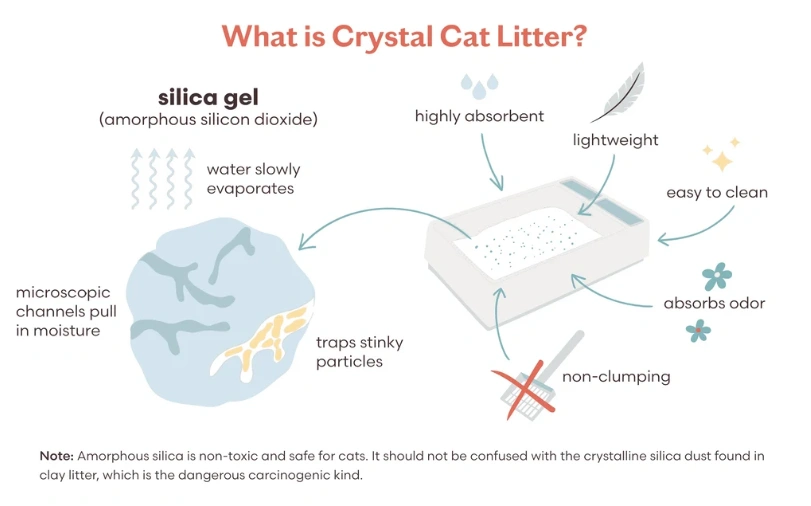
The working principle of crystal cat litter is closely related to the moisture-absorbing properties of silica gel. When liquid comes into contact with the particles, the material absorbs and retains moisture within its porous structure. This allows the litter to take in liquid without relying on the same clumping mechanism used by bentonite cat litter.
This absorption process is one of the main reasons crystal cat litter has a different appearance and usage pattern from clay-based litter. Instead of forming a solid clump immediately after absorbing urine, silica gel particles retain moisture inside the material.
The physical properties of the finished particles are important for their performance. Particle size, particle uniformity, moisture condition, and the quality of the silica gel raw material can all affect the final product.
For this reason, production equipment needs to maintain consistent material handling and screening conditions. If the finished particles contain too many oversized or undersized pieces, the product may have an inconsistent appearance and different absorption behavior.
The production process therefore places considerable attention on screening and moisture control. The current WINWORK process description specifies initial screening of silica gel raw material and further screening with a tumbler sifter to remove oversized or undersized particles.
Crystal Cat Litter vs. Other Types of Cat Litter
Different cat litter materials have different physical properties, so their production processes and equipment requirements are not exactly the same.
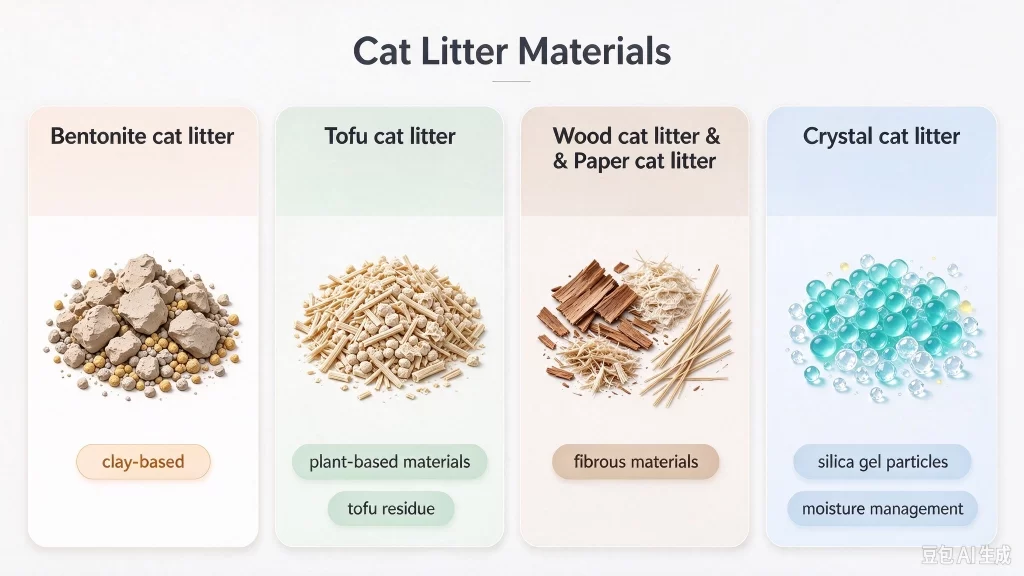
Bentonite cat litter is clay-based and is commonly associated with clumping performance. Its production may involve crushing, screening, drying, and pelletizing or granulation to achieve the required particle size and shape.
Tofu cat litter is generally made from plant-based materials such as tofu residue or other agricultural ingredients. Depending on the formula, it may require crushing, mixing, drying, forming, and screening.
Wood cat litter and paper cat litter use fibrous materials. Their production can involve shredding or crushing, drying, screening, forming, cooling, and packaging.
Crystal cat litter is different because silica gel particles are normally processed with a stronger focus on particle screening and moisture management. The objective is to obtain particles with suitable size, shape, cleanliness, and moisture condition rather than simply forming particles through a conventional granulation process.
What Equipment Is Needed for Crystal Cat Litter Production?
The main equipment used for crystal cat litter production can be divided according to its function. Not every project requires exactly the same machines, but several equipment categories are commonly important.
Raw Material Hopper
A raw material hopper stores silica-based raw materials before processing and provides a stable supply to the production line.
Main function: Stores and feeds raw materials continuously.
Feeding Machine
A feeding machine controls the amount of material entering the processing equipment and helps maintain a stable material flow.
Main function: Provides uniform and controlled feeding.
Mixer
A mixer is used when silica-based raw materials need to be blended with other ingredients, such as colorants, fragrances, or functional additives.
Main function: Mixes different materials evenly before further processing.
Granulation or Pelletizing Machine
The granulation machine forms the processed material into uniform crystal particles when the production process requires particle formation.
For silica gel cat litter, the granulation method is not always the same. Some production processes use a disc granulator (pan granulator), while other processes use specialized mechanical shaping or pressing equipment. The choice depends on the raw material condition and the required particle size and shape.

Main function: Forms silica-based material into particles with the required size and shape.
Drying Machine
A drying machine removes excess moisture from the silica gel material or newly formed particles.
For silica gel cat litter, drying is important because moisture control affects the stability and performance of the finished crystals. Some production processes use drying chambers or specialized low-temperature drying systems to protect the porous structure of the silica gel.
Main function: Reduces moisture and helps stabilize the finished crystal particles.
Screening Machine
A screening machine separates silica gel particles according to size. It removes oversized particles, undersized particles, and unwanted fines to produce a more uniform finished product.
A vibrating screener or vibrating screening machine can be selected according to the material characteristics and required capacity.
Main function: Controls particle size and separates qualified crystals from unqualified material.
Dust Collector
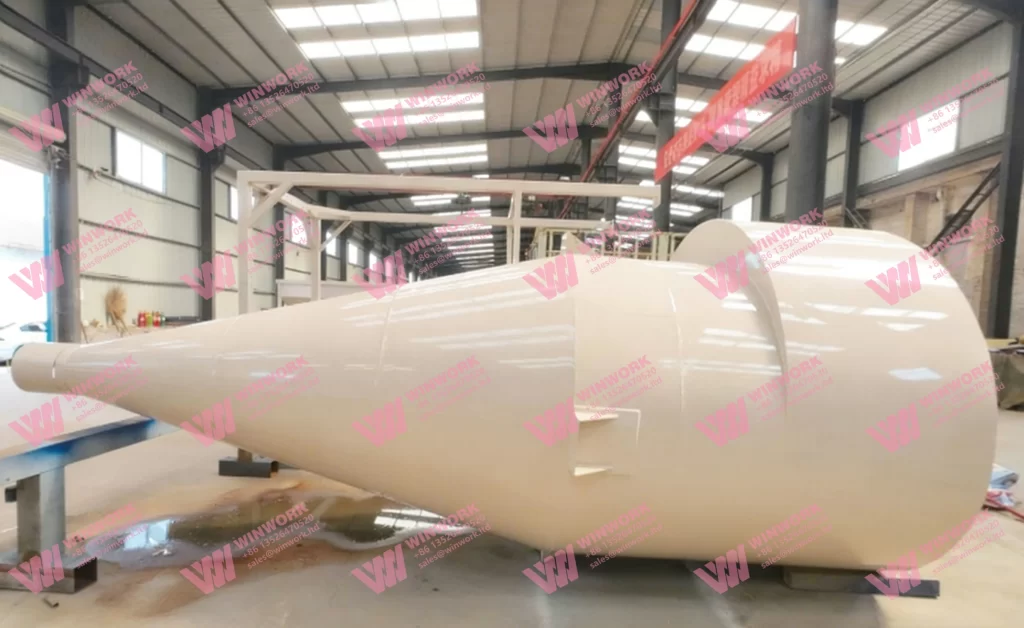
Using Dust Collector to Handle Workshop Dust
A dust collector captures fine particles generated during crushing, screening, conveying, and other dry-processing operations.
Dust removal is particularly useful for silica-based materials because fine particles can be generated during particle handling and screening.
Main function: Collects dust and helps maintain a cleaner production environment.
Conveyor
A belt conveyor or other suitable conveying system transfers materials between different processing machines.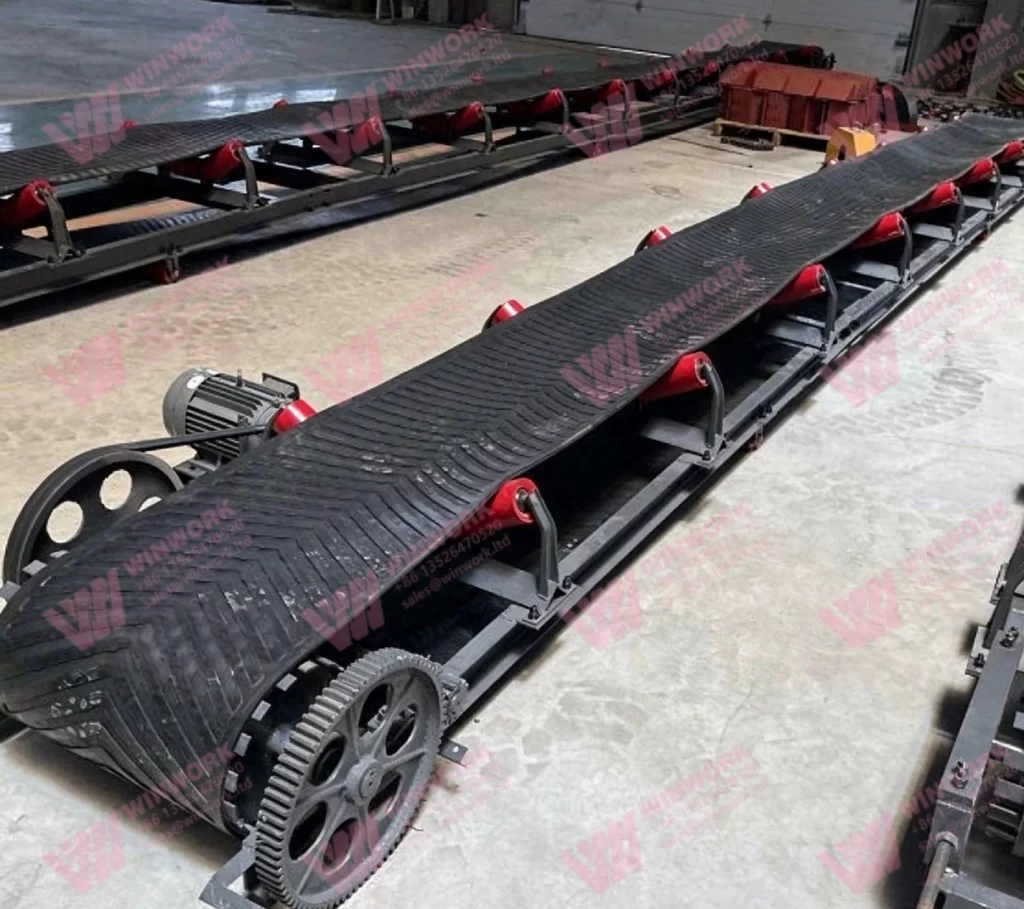
It connects the production stages and reduces the need for manual material handling.
Main function: Transfers raw materials and finished particles between machines.
Cooling Machine
A cooling machine can be used after drying to reduce the temperature of the processed particles before final screening and packaging.
Main function: Cools the material and prepares it for subsequent processing.
Automatic Packaging Machine
An automatic cat litter packaging machine weighs the finished silica gel cat litter and fills it into bags according to the preset weight.
The packaging system can be configured according to bag size, package weight, production capacity, and automation requirements.
Main function: Weighs and packs finished crystal cat litter.
Typical Silica Gel Cat Litter Production Flow
Depending on the raw material and production method, a silica gel cat litter line may follow a process such as:
Raw Material Storage → Feeding → Mixing → Granulation/Forming → Drying → Screening → Dust Removal → Cooling → Packaging
Not every production line requires all of these machines. For example, if the factory purchases ready-made silica gel crystals, a crusher and granulator may not be necessary. In contrast, a production process that forms crystal particles from silica-based raw materials requires dedicated forming or granulation equipment.
How Is a Crystal Cat Litter Production Line Different?
The biggest difference is that different cat litter materials require different processing methods.
For bentonite cat litter, crushing and granulation are usually more important because the clay material needs to be processed into particles with the required shape and clumping characteristics.
For paper and wood cat litter, shredding, drying, forming, and screening can become important because the raw materials are fibrous and have different moisture characteristics.
For crystal cat litter, the production process places greater emphasis on the quality of silica gel raw material, screening, particle uniformity, and moisture control.
This means that a manufacturer should not choose equipment simply because it is advertised as a “cat litter machine.” The correct equipment depends on what material will be processed and what type of finished product is required.
For example, a project using ready-made silica gel particles may require a different equipment combination from a project that starts with a different raw material condition. Similarly, a small packaging operation will have different requirements from a continuous industrial production plant.
How to Choose Equipment for Crystal Cat Litter Production
Before purchasing equipment, a manufacturer or investor should prepare several basic production parameters.
First, determine the raw material. The equipment should be selected according to the actual silica gel material, its particle condition, impurity level, and moisture.
Second, determine the required capacity. A small workshop and a large continuous production plant will need different feeding, screening, drying, conveying, and packaging capacities.
Third, determine the target particle size. Since screening is an important part of crystal cat litter production, the desired particle range should be clearly defined before selecting the screening equipment.
Fourth, determine the final moisture requirement. This information helps determine whether drying is required and how the drying section should be configured.
Finally, consider packaging requirements. Bag size, packaging speed, weighing accuracy, and automation level can affect the final packaging system.
A professional machinery manufacturer can then design the equipment combination around these parameters instead of offering a fixed production line that may not match the actual project.
Conclusion
A crystal cat litter production line is a complete processing system rather than a single machine. Its main functions can include raw material handling, screening, drying, conveying, supporting treatment, and packaging. The exact equipment configuration depends on the characteristics of the silica gel raw material, production capacity, particle size, moisture requirements, and packaging specifications.
The working principle of crystal cat litter is mainly based on the moisture-absorbing properties of silica gel. This makes its production requirements different from bentonite, tofu, wood, and paper cat litter.
For businesses planning to produce crystal cat litter, the most important step is to match the equipment with the actual raw material and final product requirements. A properly designed production line can provide more consistent particle size, moisture control, material handling, and packaging performance.
If you are planning a new crystal cat litter project, providing information about your raw material, required capacity, particle size, moisture requirements, and packaging specifications can help a machinery manufacturer develop a more suitable production solution.
In short, crystal cat litter requires a production system designed around silica gel processing rather than a standard line for every type of cat litter. With suitable screening, drying, conveying, and packaging equipment, a crystal cat litter production line can be configured according to different commercial production requirements.
For more details, please feel free to contact us.
Email: sales@lanesvc.com
Contact number: +8613526470520
Whatsapp: +8613526470520
Your choice is the best recognition for us!


Get A Quote