

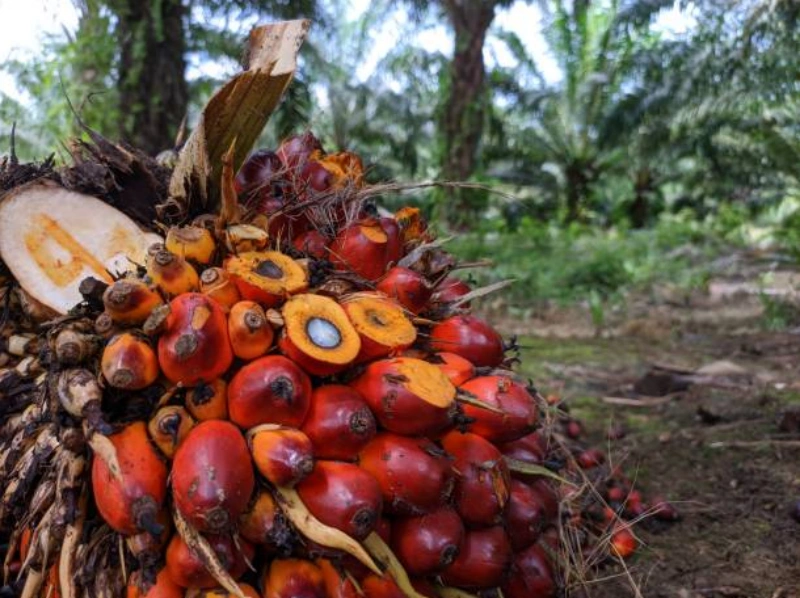
What Happens to Palm Oil Waste After Oil Extraction?
In Indonesia and Malaysia, palm oil processing is part of everyday agricultural business. After fresh fruit bunches arrive at a mill, the extraction process produces crude palm oil as well as several types of residues. For mill operators, these materials create a practical question: what should happen to the growing piles of empty fruit bunches, fibers, and other organic by-products?
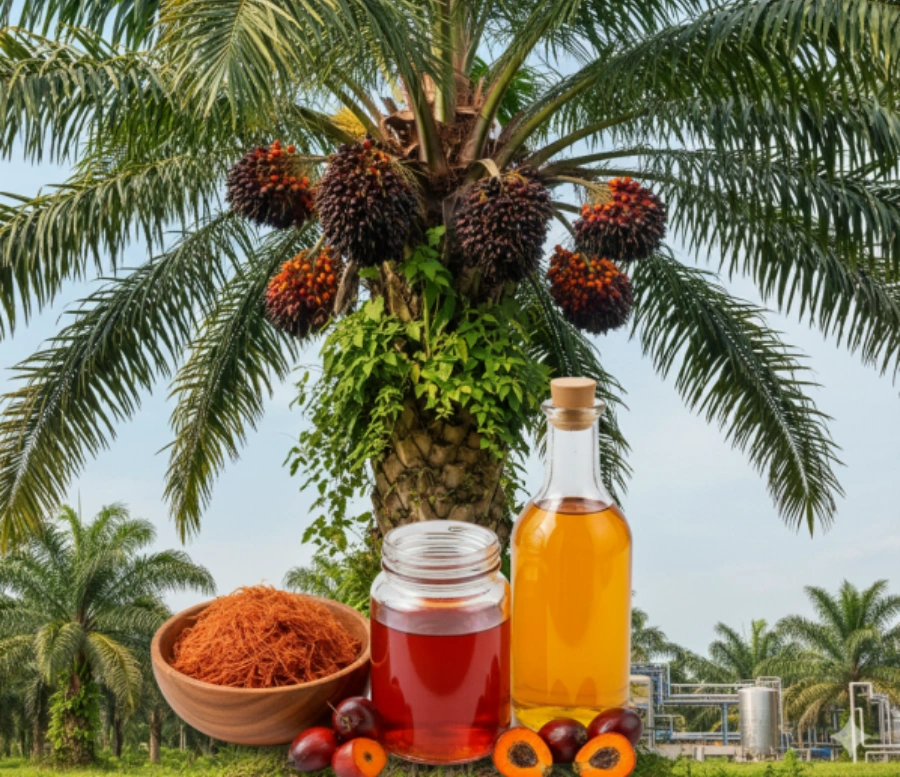
Indonesia and Malaysia are especially important markets for palm oil waste management because they account for the majority of global palm oil production. The residues generated by a mill depend on its processing technology, but common examples include empty fruit bunches (EFB), mesocarp fibers, palm kernel shells, decanter cake, and palm oil mill effluent (POME). These materials should not all be treated in the same way. Fibers and shells may be used as biomass fuel, while EFB and selected organic residues can be considered for composting after their properties have been assessed.
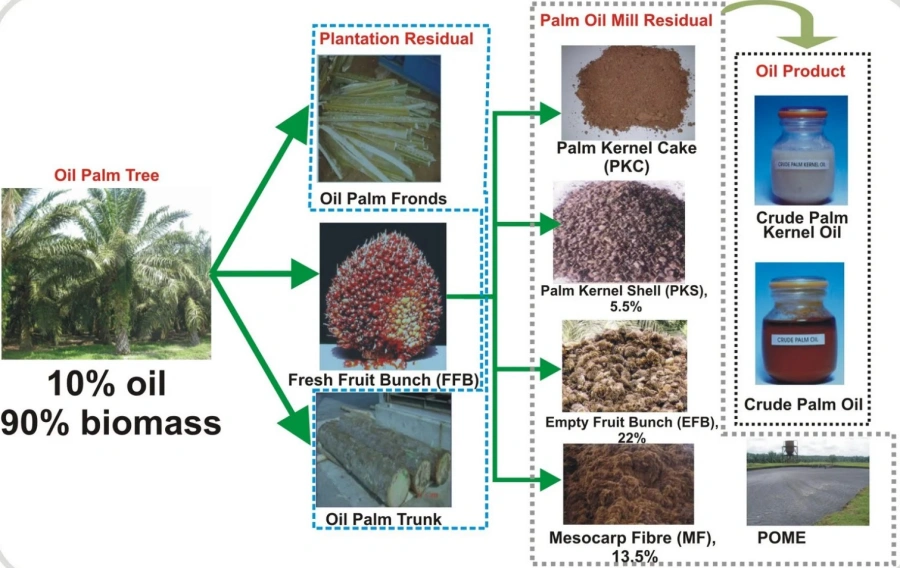
The scale of the opportunity can be significant. A systematic review of palm oil processing reported that processing one tonne of fresh fruit bunches can generate approximately 0.20–0.23 tonnes of EFB, alongside other solid residues and wastewater. This means palm oil waste can accumulate quickly at mills with high daily processing volumes. Actual quantities vary between mills, so operators should use their own production records when planning a project.
For a mill processing 100 tonnes of fresh fruit bunches daily, even the published EFB range suggests a substantial quantity of fibrous material to manage. Leaving it in unmanaged piles can occupy valuable space and make handling more difficult during rainy weather.
However, not every residue needs to become fertilizer. The first step is to identify which materials are available in sufficient quantities, which already have another use, and which can be processed safely and economically. With this information, a mill can evaluate whether palm oil waste composting is a practical addition to its existing operation.
Which Types of Palm Oil Waste Can Be Used for Fertilizer?
Before selecting a machine, examine the physical condition and intended use of each type of palm oil waste. A mixture that looks suitable from the outside may contain too much water, too many coarse fibers, or ingredients that need separate treatment. Understanding these differences helps operators choose an appropriate composting process before investing in fertilizer equipment.
Empty fruit bunches need size reduction
Empty fruit bunches are among the most common solid forms of palm oil waste generated during palm oil processing. They are bulky and fibrous, and large, intact pieces are difficult to mix evenly. Without suitable size reduction, this material may decompose more slowly and make the composting process harder to control.
A practical starting point is to shred EFB into smaller pieces before composting. A 2025 study of a particular EFB co-composting system used particle sizes of approximately 2 cm and moisture levels of 55%–65%. These were experimental conditions, not a universal requirement for every industrial plant. Nevertheless, they provide useful reference points for designing a small trial.
For a local mill, the important question is whether the shredded material mixes evenly with the other ingredients and maintains enough air space for aerobic decomposition. If long fibers wrap around mixing equipment or create dense clumps, the shredding stage may need adjustment before the plant increases capacity.
POME requires controlled handling
Palm oil mill effluent is a liquid by-product containing water and organic matter. Some composting systems use suitable POME-derived materials to provide moisture and nutrients to solid residues. However, untreated POME should not simply be poured over EFB without checking the recipe and the requirements of the wastewater treatment system.
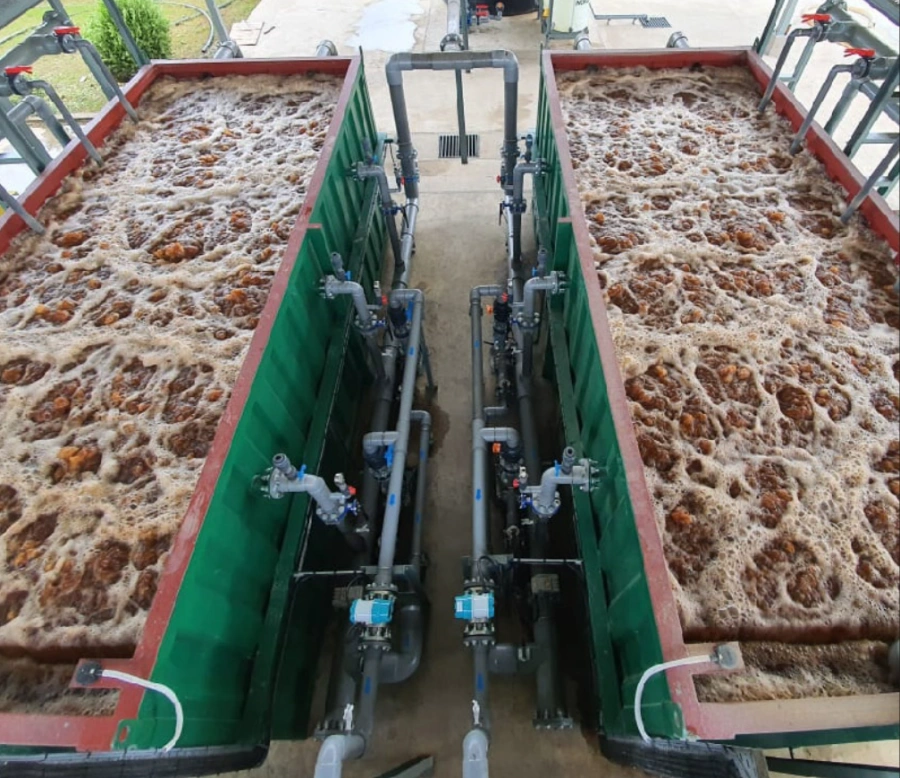
Approximately 1–1.5 cubic metres of POME per tonne of EFB produced suitable moisture and air-space conditions. This approach could not absorb all the POME generated by the mill. At the same time, it is very important to set up a rain-shielding facility for the composting area, control the amount of liquid added, and recover the leachate.
This matters in Indonesia and Malaysia, where heavy rainfall can add water to an already wet pile. A fertilizer project should not be designed on the assumption that all wastewater can be absorbed by compost. Remaining POME must continue through an appropriate treatment process and comply with local environmental requirements.
Other residues need a separate assessment
Decanter cake and selected organic sludge materials may contribute organic matter or nutrients, but their moisture, salinity, composition, and contamination risks can vary. Palm kernel shells and mesocarp fibers may already have value as boiler fuel, so diverting them to fertilizer production could compete with an existing energy use.
Before combining different materials, test representative samples for moisture, pH, organic matter, carbon-to-nitrogen ratio, and nutrient content. Check additional contaminants when the source or intended use requires it. The result should be a documented raw-material recipe that operators can repeat, rather than a mixture that changes unpredictably from one batch to the next.
Managing palm oil waste Through Practical Composting
oisture, aeration, particle size, and temperature all influence the composting process. For a mill in Sumatra, Kalimantan, Sabah, or Sarawak, processing palm oil waste requires particular attention to rainfall and humidity. Protecting the working area and monitoring the pile with actual measurements are more reliable than estimating conditions from appearance alone.
Keep moisture within a measured range
For an initial aerobic composting trial, 55%–65% moisture is a reasonable reference range supported by an EFB co-composting study. When processing palm oil waste, operators should treat this range as a starting point rather than a fixed requirement. Other systems may use different operating conditions, depending on the feedstock and process design.
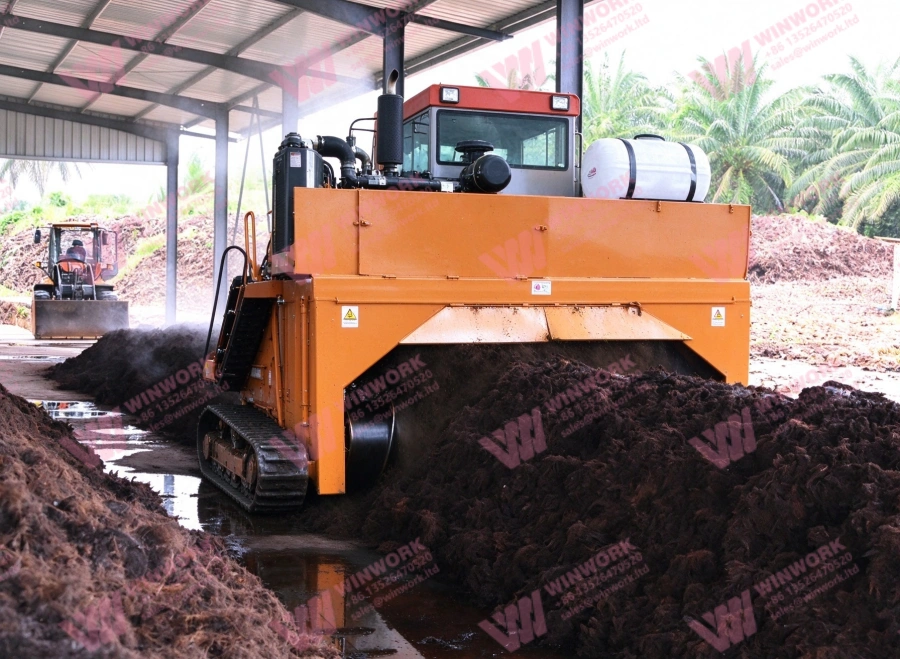
Do not add water simply because the outer surface looks dry. Take representative samples from several locations and depths, then measure their moisture content. A pile may be wet in the centre but dry near the surface, particularly after rainfall or uneven liquid application.
A hand-squeeze check can be used as a quick screening method. Properly conditioned material should feel moist and hold together loosely without releasing a stream of water. If water runs out when squeezed, inspect drainage and reduce further liquid addition. If the material is dusty and falls apart immediately, check whether measured moisture is too low.
When adding water or a suitable treated liquid, distribute it gradually while turning or mixing the material. Avoid pouring a large volume into one spot, because this can create waterlogged pockets. Record moisture readings before and after adjustment so the operator can improve the next batch.
Manage airflow and temperature
Aerobic microorganisms need oxygen to break down organic material. During palm oil waste composting, a compacted pile with excessive moisture can lose air space, causing unpleasant odors and slowing decomposition. An overly dry pile, meanwhile, can reduce microbial activity. Maintaining the right balance between moisture and airflow helps create more consistent composting conditions.
For a first trial, establish a windrow or another suitable composting arrangement on a properly drained, impermeable surface. Provide a roof or effective rain protection where practical, and collect leachate rather than allowing it to run into surrounding soil or waterways.
Check pile temperature at several points each day during the active phase. A sustained rise indicates microbial activity, but a single high reading does not prove that the whole pile has reached the same temperature. If temperatures differ sharply between the centre and the outer layer, review pile size, turning, moisture distribution, and airflow.
Turning should respond to actual conditions. One study used turning intervals of several days, while other systems use longer intervals. Neither schedule should be applied automatically to every mill. Turn when the pile becomes compacted, develops uneven temperatures, or shows signs of insufficient aeration, while avoiding unnecessary turning that increases labor and heat loss.
Keep a simple daily record of temperature, moisture, rainfall, turning dates, odors, and leachate. These records help identify whether poor composting is caused by the raw-material recipe, excessive water, insufficient aeration, or inconsistent operation.
Allow time for maturation
Composting time depends on the material, particle size, moisture, turning method, and local weather. The active processing period for general fruit-stem composting is approximately 40 to 60 days, but the end of that period does not automatically mean the product is mature.
Before selling or applying compost, check whether the temperature has stabilized, the material has developed a reasonably uniform appearance, and the product meets relevant maturity and quality requirements. Test nutrient content, pH, salinity where relevant, and contaminants according to the intended market and local regulations.
The purpose of palm oil waste composting is not simply to make a pile look darker. It is to produce a stable, usable material with predictable characteristics.
How Transport and Site Conditions Affect Project Costs
For a mill in Indonesia or Malaysia, the distance between the residue source, composting area, and final customer can determine whether a palm oil waste project is commercially attractive. Fresh EFB is bulky, and moving untreated material over long distances may be expensive relative to its value. Comparing local processing with centralized composting can help operators identify a more practical arrangement.
Start by obtaining local quotations and confirming how transport is charged. A contractor may quote per truck trip, per tonne, per kilometre, or according to a combination of distance and load. These pricing methods are not interchangeable.
For example, a mill generating 10 tonnes of EFB per day should compare the total daily cost of collecting and moving that material to a nearby site against the cost of transporting it to a facility 30 km away. Include loading, unloading, fuel surcharges, waiting time, return trips, road conditions, and seasonal access. Do not rely on distance alone or assume that a quoted rate includes every expense.
Three arrangements are worth comparing:
- On-site composting: The mill processes suitable residues near the point of generation, reducing the need to transport bulky raw material. This option requires sufficient land, drainage, odor management, and an appropriate operating area.
- Nearby centralized composting: Several mills or agricultural businesses supply one facility. Shared equipment may improve utilization, but collection routes and supply schedules must be reliable.
- Transporting finished compost: The mill stabilizes the raw material locally and ships the finished product to plantations or other customers. Whether this saves money depends on the actual reduction in mass and volume, handling costs, and customer location.
Do not assume that every tonne of incoming wet material becomes a tonne of saleable compost. Water evaporates, organic matter decomposes, and some material may be removed during screening. A pilot batch provides more reliable information about finished output than a theoretical estimate.
The feasibility study should also account for land preparation, electricity, labor, machinery maintenance, wastewater management, product testing, storage, and packaging. In wet tropical regions, drainage and rain protection deserve particular attention because waterlogged material can increase handling problems and delay production.
Choosing Fertilizer Equipment for Palm Oil Waste
Once the raw materials and composting process have been assessed, equipment selection for palm oil waste becomes much more straightforward. The objective is not to purchase the largest machine available, but to build a process that can handle the material consistently at the required capacity. A suitable configuration should match the feedstock condition, daily output, and intended fertilizer product.
A typical organic fertilizer project may use a shredder to prepare EFB, a loader or conveyor for handling, a mixer for blending ingredients, and a compost turner or another suitable aeration system. Screening equipment can separate oversized pieces from the finished compost.
If the business intends to sell granular organic fertilizer, additional equipment may include a fertilizer granulator, dryer, cooling equipment, screening system, and packing machine. The appropriate configuration depends on the moisture, particle size, maturity, and physical characteristics of the compost entering the finishing stage.
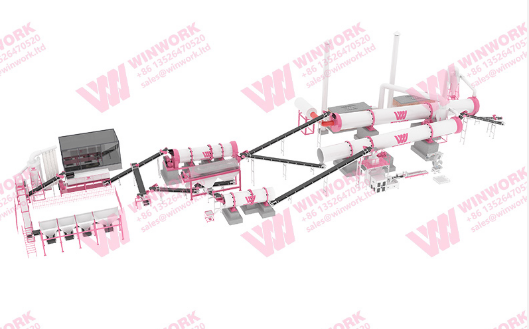
Raw EFB is not automatically ready for direct granulation. In many projects, the material must first be composted and stabilized. If the incoming material is too wet or contains long fibers, selecting a granulator before testing the upstream process may lead to poor granule formation, unstable output, or additional drying costs.
When discussing a palm oil waste project with an equipment supplier, provide the daily quantity of each raw material, measured moisture, intended finished product, target production capacity, available site area, and local electricity supply. Also explain whether the project will produce loose compost, powder, or granules. These details help the supplier evaluate a suitable process rather than recommending equipment based on a keyword or a single capacity figure.
You can review organic fertilizer production line options and fertilizer production equipment to understand the types of systems available. Final selection should follow raw-material testing, process trials, and an engineering assessment of the proposed site.
Is Turning Palm Oil Waste into Organic Fertilizer Worthwhile?
For palm oil mills, the value of palm oil waste recovery depends on more than the quantity of residues available. A practical palm oil waste fertilizer project needs a stable feedstock supply, controlled composting, manageable transport costs, and a reliable market for the finished product.
Start with a representative trial before investing in a complete production line. Record the raw-material quantities, moisture changes, turning frequency, labor, electricity use, and processing time. Test the resulting compost and calculate the actual cost per tonne of saleable product, including screening losses, storage, packaging, transport, and quality control.
It is equally important to identify the customer before expanding production. Nearby oil palm plantations may be potential users, but their willingness to purchase or apply the compost should be confirmed. Product quality, nutrient content, application requirements, competing fertilizers, and local regulations will influence demand.
For a mill with consistent supplies of suitable EFB, a controlled composting area, and access to agricultural customers, an organic fertilizer project may create a useful outlet for selected residues. Where transport is expensive, wastewater treatment is a constraint, or product demand is uncertain, improving existing waste handling or partnering with a nearby composting facility may be a better first step.
The most reliable way to manage palm oil waste is to begin with local materials, measure the process under real operating conditions, and expand only when the technical results and commercial case support the investment. By treating palm oil waste as a potential resource rather than simply a disposal burden, mills can make more informed decisions about organic fertilizer production and equipment investment.
For more details, please feel free to contact us.
Email: sales@lanesvc.com
Contact number: +8613526470520
Whatsapp: +8613526470520
Get A Quote