

Introduction
Tomato growers often face challenges such as imbalanced nutrition, soil-borne diseases, and unstable yields. Liquid Fertilizer for Tomatoes, a fast‑absorbing and precisely formulated liquid nutrient solution, is becoming a key tool for improving quality and productivity. This press release addresses common tomato growing problems, explains how to produce high‑quality Liquid Fertilizer for Tomatoes through production‑line fertilizer and fertilizer manufacturing technologies, details the typical equipment, outlines core benefits. We write so detail to help growers fully understand and adopt this solution for efficient, stable, and sustainable tomato production.
Why Liquid Fertilizer for Tomatoes Is Needed
Tomatoes have a short growth cycle, high nutrient demand, and strict requirements for nutrient form and delivery timing. Growers frequently encounter:
Imbalanced Nutrition – Traditional solid fertilizers can become fixed in soil or distribute unevenly, causing deficiencies in some plants and excessive growth in others.
Slow Root Uptake – Solids must dissolve and diffuse before absorption, which is inefficient under low temperature or drought conditions.
Diseases and Soil Constraints – Continuous cropping and soil‑borne pathogens weaken root activity and limit nutrient use efficiency.
Complex Water‑Fertilizer Management – Manual top‑dressing is labor‑intensive and prone to concentration errors, risking root burn or under‑nutrition.
To solve these issues, Liquid Fertilizer for Tomatoes offers rapid solubility and can be applied via fertigation or foliar spraying, delivering balanced nutrients directly and quickly to plants. This significantly improves fertilizer efficiency and has become essential in modern tomato cultivation.
Producing Liquid Fertilizer for Tomatoes
For stable supply of high‑quality Liquid Fertilizer for Tomatoes, manual preparation cannot meet the needs of scale and standardization. A production‑line fertilizer system enables batch production with controlled quality and safety.
Raw Material Selection and Pre‑Processing
Basic Nutrient Sources: Ammonium nitrate, urea (N), monopotassium phosphate, superphosphate (P), potassium sulfate (K), and chelated trace elements (Fe, Zn, Mn, Cu, B, Mo).
Organic Liquid Base: Fermented livestock manure water, fish protein hydrolysate, seaweed extract – these enhance tomato flavor and disease resistance.
Pre‑Processing: Solid inputs are ground to 40–60 mesh; liquid bases are filtered to remove impurities, ensuring uniform mixing.
Formulation Design and Mixing
Formulas vary by growth stage:
Seedling Stage: High N, low P and K to promote vegetative growth.
Flowering and Fruit Set: Balanced N and P, slightly higher K to aid flower differentiation and fruit set.
Fruit Expansion: High K, lower N to promote fruit enlargement and sugar accumulation.
In fertilizer manufacturing, automatic dosing pumps and inline mixing tanks precisely control component ratios, ensuring each batch of Liquid Fertilizer for Tomatoes maintains consistent nutrient levels.
Dissolution and Chelation Reaction
Add dry ingredients to warm water (40–60 °C) with stirring until fully dissolved. Then add chelating agents (EDTA, DTPA) and organic acids to keep trace elements water‑soluble and prevent precipitation. This reaction is the core quality control step in production‑line fertilizer manufacturing of Liquid Fertilizer for Tomatoes.
Filtration & Packaging
Multi‑stage filters (100–200 mesh) remove undissolved particles and impurities for a clear liquid. The product is then packaged in 1 L, 5 L, 10 L, or bulk containers for transport and use.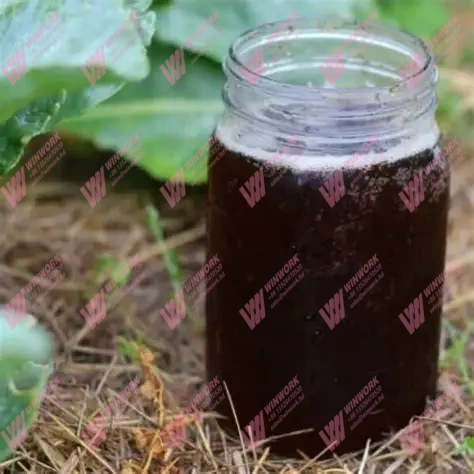
The procedure and some machines
Liquid Fertilizer Production Line is a set of modern production system integrating automatic control, efficient production and precise proportioning, which is specially used for producing liquid fertilizer. Liquid fertilizer is favored by agricultural growers because of its uniform nutrient composition, fast absorption and convenient use.
The liquid fertilizer production line can realize the automatic operation of the whole process from raw material proportioning, mixing, dissolving, filtering, filling to packaging, which can effectively improve the production efficiency and ensure the stability and quality of the products.
Liquid fertilizer production line equipment composition
Raw material dosing system: responsible for the accurate weighing and transportation of raw materials to ensure that the proportion of each raw material is accurate.
Mixing and Dissolving System: Efficient mixing equipment and dissolving tanks can quickly and evenly dissolve various nutrients in the liquid substrate.
Filtration system: multi-stage filtration equipment ensures the purity of liquid fertilizer and avoids the influence of impurities on product quality.
Automatic filling machine: high-precision filling equipment to ensure consistent capacity of each bottle of liquid fertilizer, fast filling speed and high efficiency.
Capping and packaging machine: automatically complete a series of operations such as capping, labeling, packaging, etc. to ensure that the product is beautiful and well sealed.
Quality inspection system: automated inspection equipment for real-time monitoring and inspection of each batch of products on the production line to ensure stable product quality.
Centralized control system: the whole production line is equipped with PLC control system, which can adjust the production operation at any time.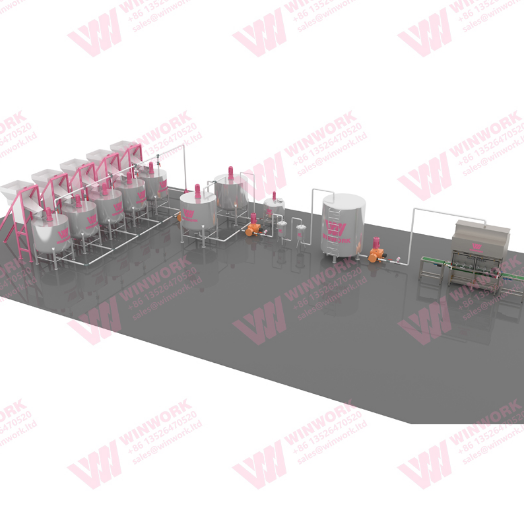
Core Advantages of Liquid Fertilizer for Tomatoes
Fast Absorption, High Efficiency – Liquid form allows direct uptake by roots or leaves, reducing delivery time and increasing utilization rate by 30%–50% over solids.
Precision Feeding – Formulas can be adjusted for growth stage and soil test results, avoiding excess or deficiency.
Irrigation Compatibility, Works seamlessly with drip and spray systems for integrated water‑fertilizer management, saving labor and reducing waste.
Improved Rhizosphere Environment, Organic Liquid Fertilizer for Tomatoes stimulates beneficial microbial activity, alleviating continuous cropping stress.
Better Quality and Yield, Balanced nutrition promotes uniform fruit expansion, higher sugar content, brighter color, with yield increases of 15%–25%.
Safety and Eco‑Friendliness, Controllable formulation reduces over‑fertilization risks, preventing soil salinization and non‑point pollution.
FAQ
Q1: Is Liquid Fertilizer for Tomatoes suitable for all growing systems?
A: Yes – it works in open fields, greenhouses, polytunnels, and hydroponics; adjust concentration and frequency according to irrigation method.
Q2: What’s the difference between homemade and production‑line Liquid Fertilizer for Tomatoes?
A: Homemade versions suffer from raw material purity and proportion errors; production‑line fertilizer uses fertilizer manufacturing equipment and QC systems for precise, stable nutrient content.
Q3: How to determine application concentration?
A: Seedlings 0.2%–0.3%, flowering/fruit set 0.3%–0.5%, fruit expansion 0.5%–0.8%, modified by soil test results.
Q4: Can it be mixed with pesticides?
A: Some pesticides are compatible, but always conduct a small‑scale compatibility test first to avoid chemical reactions that reduce efficacy.
Q5: Is organic Liquid Fertilizer for Tomatoes slower to act?
A: Compared with pure chemical liquid fertilizers, organic types act more slowly but have longer residual effects and improve soil health, benefiting long‑term yield and quality.
Conclusion
Addressing real tomato growing challenges, Liquid Fertilizer for Tomatoes provides an efficient, precise, and environmentally friendly nutrient supply method. Through production‑line fertilizer and modern fertilizer manufacturing, growers can obtain stable, high‑quality liquid fertilizer and integrate it with fertigation systems for smart water‑fertilizer management. We provide this service to emphasize its unique value in boosting absorption efficiency, precise control, rhizosphere improvement, and yield and quality gains. Looking ahead, with intelligent fertilizing and digital agronomy, Liquid Fertilizer for Tomatoes will play an even bigger role in tomato and other fruit‑vegetable production, advancing agriculture toward higher efficiency and sustainability.
For more details, please feel free to contact us.
Email: sales@lanesvc.com
Contact number: +8613526470520
Whatsapp: +8613526470520
Get A Quote