

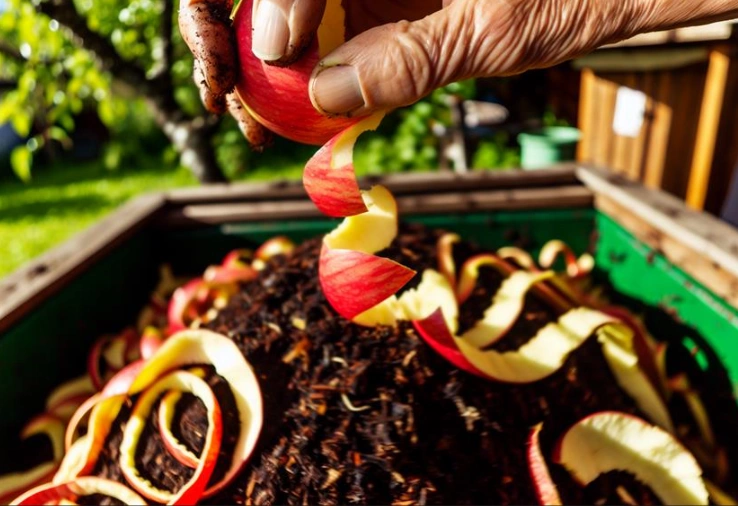
Apple pomace is a common by-product of apple processing. It includes materials such as apple skins, pulp, seeds, and other solid residues left after producing juice, cider, and other apple-based products. Instead of treating this material simply as waste, it can be used as an organic raw material and processed into a useful fertilizer product.
Apple pomace generally contains considerable moisture and biodegradable organic matter, which means it needs proper treatment before further agricultural use. Research has also investigated composting and other ways to recover value from apple processing residues.
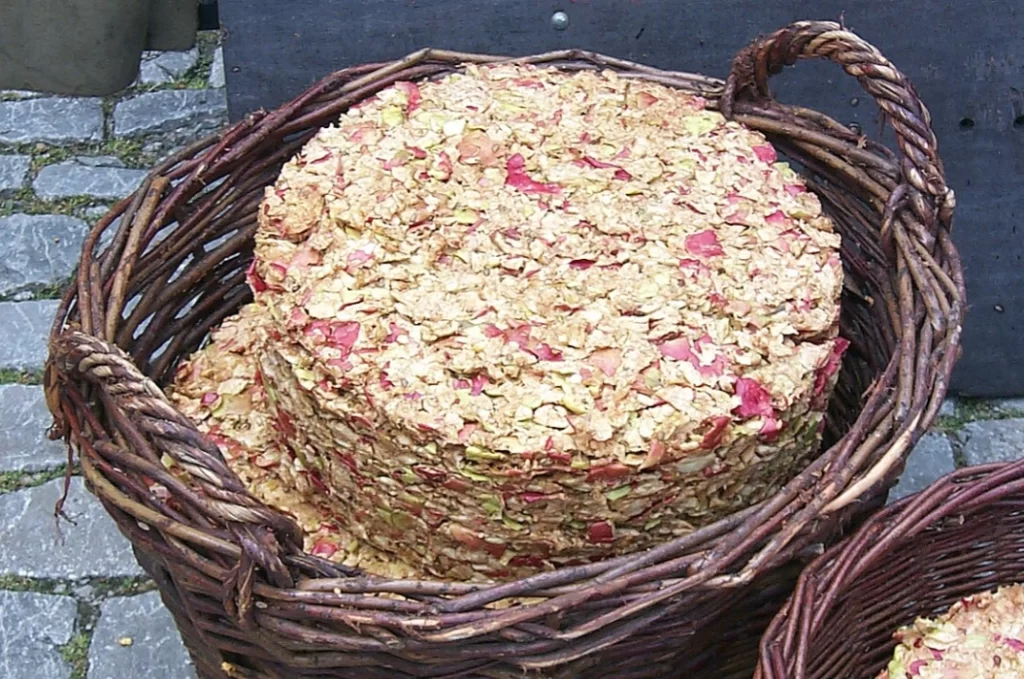
Apple Pomace
For producers with a stable supply of apple processing waste, turning it into apple pomace fertilizer can be a practical way to recover organic matter and naturally occurring nutrients while reducing the amount of fruit-processing residue that needs to be handled.This article explains the main process, from preparing fresh apple pomace to composting, mixing, granulation, drying, screening, and final storage.
What Is Apple Pomace and Why Can It Be Used for Fertilizer?
Apple pomace is the solid by-product left after apples are processed to make juice, cider, applesauce, and other apple-based products. It mainly consists of apple pulp, skins, seeds, and small pieces of fruit that remain after most of the liquid has been extracted. Because it comes directly from fruit processing, the composition of apple pomace can vary depending on the apple variety, processing method, and the part of the fruit that remains in the residue.
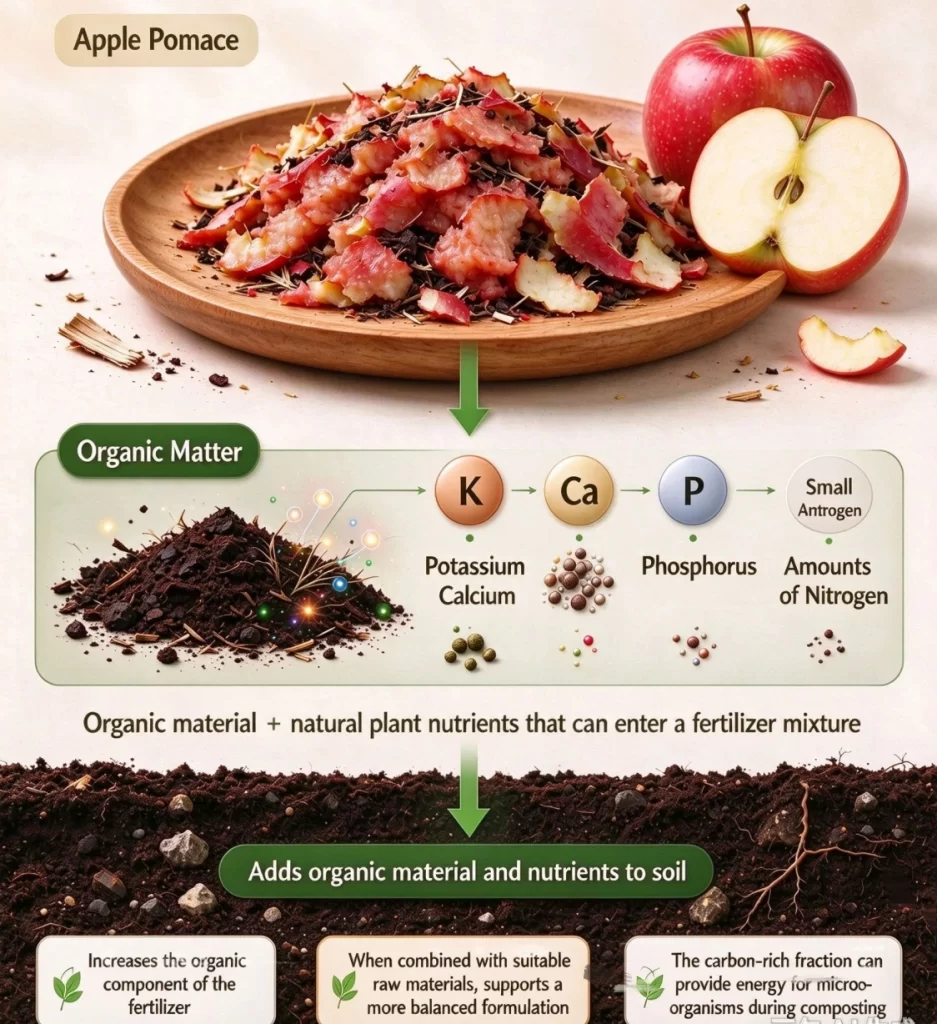
The value of apple pomace as a fertilizer raw material comes from its organic matter and naturally occurring plant nutrients, which can make it a useful feedstock for apple pomace fertilizer production. Apple pomace contains biodegradable carbon compounds, organic matter, and nutrients such as potassium, calcium, phosphorus, and small amounts of nitrogen. These components can contribute organic material and nutrients to the fertilizer mixture, while the carbon-rich fraction can also provide a useful source of energy for microorganisms during composting.
Using apple pomace for fertilizer production can therefore provide several benefits and make apple pomace fertilizer a practical option for producers looking to recycle fruit-processing residues. First, it gives a useful purpose to a large volume of fruit-processing residue instead of treating it only as waste. Second, its organic matter can help increase the organic component of the final fertilizer. Third, the nutrients naturally present in apple pomace can complement other fertilizer materials and contribute to a more balanced formulation when combined with suitable raw materials.
However, fresh apple pomace is usually not applied directly as a finished fertilizer. It has a relatively high moisture content and contains easily biodegradable organic matter, so it can decompose quickly and may be difficult to store for long periods. For this reason, apple pomace is normally processed through composting, moisture adjustment, mixing, and, when required, granulation. By combining apple pomace with other organic materials, producers can adjust the nutrient balance and physical properties of the final product.
The goal of producing apple pomace fertilizer is therefore to turn a fruit-processing by-product into a more stable and useful organic fertilizer material. Instead of simply disposing of apple residue, producers can recover its organic matter and naturally occurring nutrients and incorporate them into a fertilizer production process.
How to Make Apple Pomace Fertilizer
The production process for apple pomace fertilizer generally begins with raw material preparation and continues through moisture adjustment, composting, mixing, granulation, drying, cooling, screening, and storage.The exact process should be adjusted according to the condition of the apple pomace, the desired fertilizer characteristics, and the production scale.
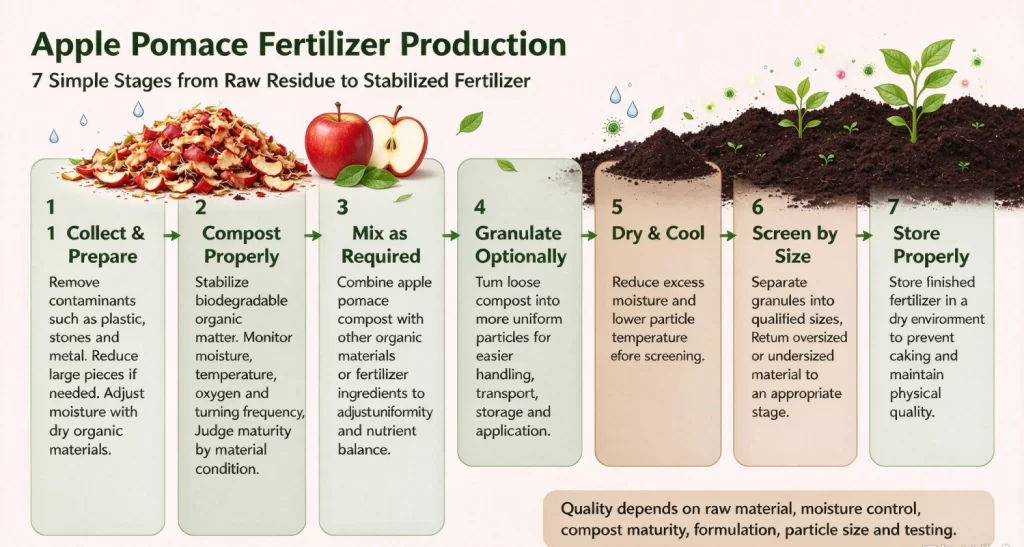
The first stage is collecting and preparing the apple pomace. Before further processing, producers should remove unwanted materials such as plastic, packaging pieces, stones, metal, or other contaminants. Keeping the raw material clean helps improve the stability of the following processing stages.
Particle size should also be considered. If the pomace contains relatively large pieces, appropriate size reduction can make the material more uniform and help microorganisms access the organic matter during composting. However, excessive grinding is not always necessary. The preparation method should match the actual condition of the raw material.
Moisture adjustment is another important step. Fresh apple pomace can contain a large amount of water, which may make the material compact and reduce air circulation during composting. If the mixture becomes too wet, anaerobic conditions may develop, resulting in unpleasant odors and slower decomposition.
When necessary, apple pomace can be mixed with drier organic materials such as straw, sawdust, dry crop residues, or mature compost. These materials can help absorb excess moisture and improve the physical structure of the mixture.
The goal is not to remove all moisture. Microorganisms need sufficient moisture for biological activity, but the mixture also needs enough air space for aerobic decomposition. The appropriate moisture condition therefore depends on the specific feedstock and composting method.
Proper composting is one of the most important stages in producing apple pomace fertilizer because it helps stabilize the biodegradable organic matter and prepares the material for further processing.

The composting period can vary considerably. Factors such as particle size, moisture, temperature, oxygen supply, raw material composition, and turning frequency can all influence the rate of decomposition. Therefore, producers should evaluate the actual condition of the compost instead of relying only on a fixed number of days.
The key objective is to allow the apple pomace to decompose sufficiently before it is used as a stabilized fertilizer feedstock. Fresh apple pomace gradually changes during composting, becoming more stable and easier to handle.
After composting, the material can be used alone or combined with other organic materials. For example, producers may mix apple pomace compost with chicken manure, cow manure, crop residues, or other composted materials. The choice depends on the desired characteristics and nutrient profile of the final product.
Mixing can make the feedstock more uniform and help adjust its overall characteristics. If a specific nutrient formulation is required, other fertilizer ingredients may also be added according to the target product.
This is important because apple pomace should not automatically be considered a complete fertilizer for every crop. The nutrient content of the final apple pomace fertilizer depends on the original raw materials, composting conditions, additional ingredients, and final formulation.
After composting and mixing, the material can be granulated if a granular fertilizer product is desired. Granulation converts loose organic material into more uniform particles that are generally easier to handle, transport, store, and apply.
A fertilizer granulator may be used at this stage, but the granulation process should be considered as part of the complete production system. Moisture, compost maturity, formulation, and material structure can all affect the granulation result.
The purpose of granulation is not simply to make the material smaller. The objective is to form particles with a suitable size and structure for the intended fertilizer product. Properly processed apple pomace fertilizer can therefore be more convenient for commercial handling than loose compost.
After granulation, the particles may contain excess moisture and heat. Drying can reduce the moisture content, while cooling helps lower the temperature before screening, packaging, and storage.
The final stage is screening. The fertilizer particles are separated according to size, allowing qualified granules to continue to packaging while oversized or undersized material can be returned to an appropriate processing stage.
The completed fertilizer should then be stored in a dry environment and protected from excessive moisture. Proper storage helps reduce caking and maintain the physical quality of the product during transportation and application.
What Affects the Quality of Apple Pomace Fertilizer?
The quality of apple pomace fertilizer depends not only on the original apple pomace but also on moisture control, composting conditions, the selection of additional raw materials, and the final processing method. Research has shown that apple pomace can vary in its physical and chemical properties depending on the source and processing conditions.
Moisture is particularly important. Excessive moisture can make transportation, storage, composting, and granulation more difficult. On the other hand, insufficient moisture can limit microbial activity during composting. Producers therefore need to manage moisture according to the requirements of each processing stage.
Compost maturity is another key factor. Fresh apple pomace is different from stabilized compost. Before further fertilizer processing, the material should be sufficiently decomposed and stable for its intended application.
The formulation also affects the final characteristics of apple pomace fertilizer. If apple pomace is combined with manure, crop residues, or other fertilizer ingredients, the nutrient profile will change. Producers should therefore determine the target product before selecting the final formulation and processing conditions.
Particle size is also important when producing granular fertilizer. Different applications may require different particle sizes, so the granulation and screening stages should be adjusted according to the intended product.
For commercial production, testing both raw materials and finished fertilizer can provide useful information about moisture, nutrient content, and other product characteristics. This can help producers maintain more consistent product quality.
Can Apple Pomace Fertilizer Be Produced on a Commercial Scale?
For a small farm, orchard, or garden, composting apple pomace may be sufficient for local use. However, apple processing companies and fertilizer producers with a regular supply of pomace may want to process it on a larger scale.
Commercial production usually requires a more consistent process. Instead of stopping after composting, producers can continue with mixing, granulation, drying, cooling, screening, and packaging. This creates a more standardized product and can make it easier to handle and distribute.
At this stage, apple pomace fertilizer becomes more than a method of organic waste disposal. It can become a value-added fertilizer product made from a regularly available processing by-product.
A complete production system can be designed according to the characteristics of the raw materials and the required output of the apple pomace fertilizer. For projects that require continuous processing, an organic fertilizer production line can be considered as part of the overall solution.
The specific configuration should be determined according to the amount and condition of apple pomace, required production capacity, target fertilizer formulation, desired granule size, and available production space. A producer handling fresh, high-moisture pomace may require a different process from one using already composted and relatively dry material.
For this reason, the production process should be designed around the raw material rather than choosing equipment first. Understanding the material at each stage can help create a more practical and efficient solution.
Conclusion
Apple pomace is more than a by-product of apple processing. With proper preparation, moisture adjustment, composting, mixing, granulation, drying, cooling, screening, and storage, it can be transformed into a useful organic fertilizer product.
The complete process can be summarized as:
Apple Pomace → Preparation → Moisture Adjustment → Composting → Mixing → Granulation → Drying & Cooling → Screening → Storage
For producers with a stable supply of apple processing waste, apple pomace fertilizer offers a practical approach to organic waste recycling and value-added fertilizer production. The final process should always be adjusted according to the raw material, target product, production capacity, and quality requirements.
For more details, please feel free to contact us.
Email: sales@lanesvc.com
Contact number: +8613526470520
Whatsapp: +8613526470520
Get A Quote