

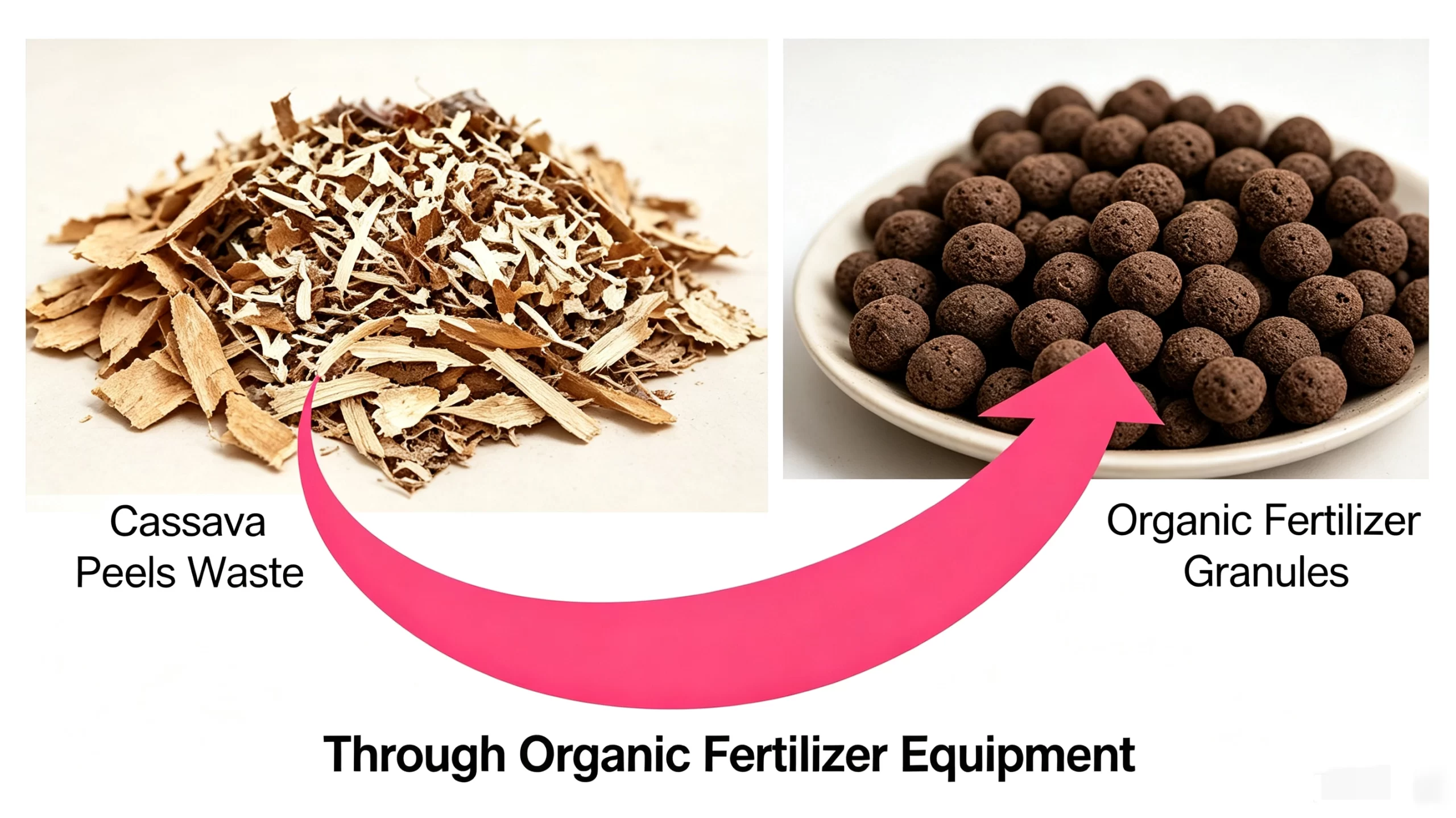
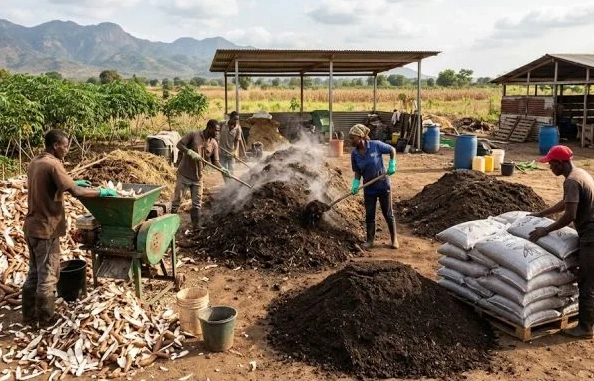
What if part of the raw material for your fertilizer production is already around you?
Across cassava-growing areas, farming and processing activities generate organic residues such as cassava peels, pulp, and fibrous materials. For some farmers and cassava processing businesses, these residues may already be available locally. Instead of viewing them only as waste that needs to be handled, they can also be considered as a potential agricultural resource.
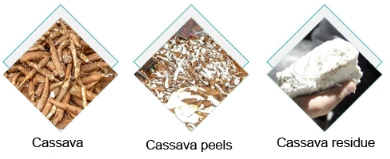
This is where cassava waste organic fertilizer becomes an interesting idea. The question is not simply whether cassava waste can be processed. The more important question is whether an existing local resource can be turned into a useful fertilizer product in a practical and economically reasonable way.
1. Cassava Waste: An Agricultural Resource That Deserves a Second Look
Cassava is an important crop in many tropical and subtropical agricultural systems. During harvesting and processing, different types of organic residues can be generated. Depending on the processing method, these may include peels, pulp, fibrous residues, and other organic by-products.
For a cassava farmer or processing company, the first value of these materials is obvious: they already exist as part of the production process.
The next question is what happens after they are generated.
If cassava residues are simply stored, transported, or discarded, their potential agricultural value may remain unused. If they are properly processed and incorporated into a suitable fertilizer production system, however, they may become a source of organic material for agricultural use.
This creates a simple shift in thinking:
Cassava Processing → Cassava Waste → Resource → Organic Fertilizer

The idea behind cassava waste organic fertilizer is therefore not to create value from nothing. It is to explore whether an existing agricultural by-product can be given another useful role.
2. Why Turn Cassava Waste into Organic Fertilizer?
The strongest reason to consider cassava residues is that the raw material may already be available.
If you operate a cassava farm, cassava processing facility, or starch-related business, you may already have a relatively stable source of organic residues. This does not mean the material is automatically free or that every project will have low production costs. Collection, transportation, storage, moisture management, and processing still have to be considered.
However, using an existing local resource can change the economics of a fertilizer project.
Instead of following a model in which all organic raw materials must be purchased from outside suppliers, a business can investigate whether part of its own agricultural residue can be incorporated into the production process.
The value comes from resource utilization.
A material that previously required handling may become a useful input. A local residue may also reduce the need to transport some external raw materials over long distances, depending on the location of the farm, processing facility, and fertilizer production site.
Most importantly, the final product has an agricultural purpose. If the resulting organic fertilizer is suitable for local crops and meets the applicable quality requirements, it may be used on farmland or introduced into a local fertilizer market.
That makes cassava waste organic fertilizer more than a waste-treatment concept. It can also be viewed as a possible connection between agricultural processing and agricultural input production.
3. Can Cassava Waste Be Used for cassava waste organic fertilizer?
Yes, cassava residues can be considered as organic material for fertilizer production, but they generally need appropriate treatment before they become a stable fertilizer product.
The exact approach depends on the characteristics of the material.
Fresh cassava residues may contain significant moisture, and different residues can vary in particle size, organic composition, and impurity levels. Therefore, the raw material should be evaluated before deciding on the processing method.
A simplified production concept can be described as:
Cassava Waste → Pretreatment → Composting or Fermentation → Adjustment and Mixing → Organic Fertilizer
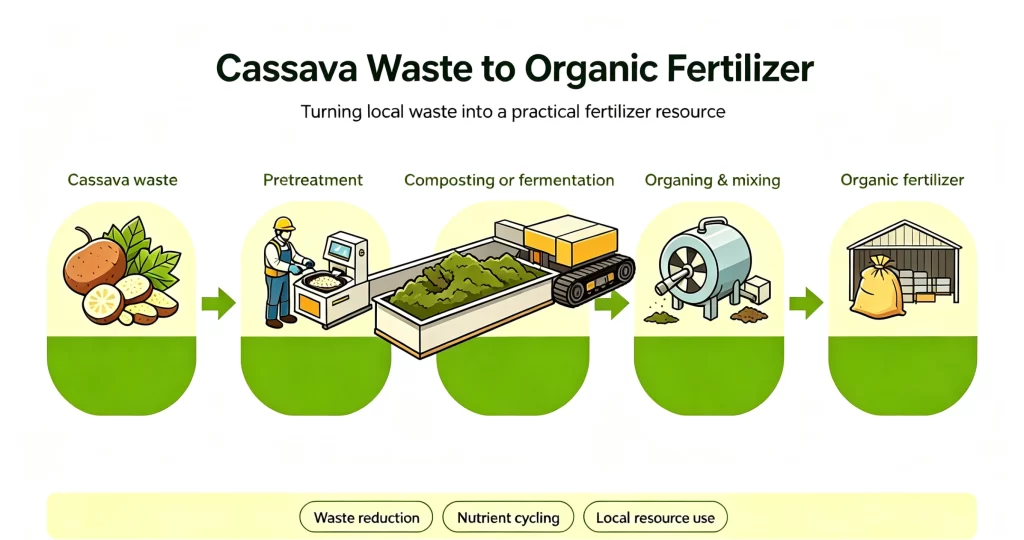
If the final product is intended to be granular, an additional granulation stage can be considered.
The purpose of the treatment is not simply to change the physical appearance of the waste. Organic materials need to be handled in a way that supports stabilization and produces a fertilizer product suitable for its intended agricultural application.
Other organic materials may also be considered depending on the desired product and local raw material conditions. For example, a project may combine cassava residues with other suitable organic materials to create a more appropriate final formulation.
This is why there is no single formula for every cassava waste organic fertilizer project. The right approach depends on the raw material, target product, production scale, and intended use.
4. Why Is This Model Worth Considering in Africa?
The potential value of cassava waste needs to be considered within the wider African fertilizer market.
Africa is not one uniform fertilizer market. Fertilizer consumption, crop requirements, supply chains, and market conditions differ considerably between countries and regions. The African Development Bank’s 2025 fertilizer market analysis highlights these regional differences and notes the importance of crop-specific fertilizer products, improved fertilizer access, and reducing import dependency through local production.
Affordability and availability are also important issues. Recent African Development Bank materials continue to identify fertilizer price pressures, supply-chain challenges, financing constraints, and market volatility as factors affecting access to fertilizer.
This does not mean locally produced organic fertilizer will automatically be cheaper than every alternative. Instead, it suggests that local agricultural resources deserve attention when evaluating possible fertilizer production models.
The policy environment is also relevant. In the 2024 Nairobi Declaration on Fertilizer and Soil Health, African leaders committed to increasing domestic production and distribution of certified organic and inorganic fertilizers by 2034. The declaration also refers to using locally available resources and developing decentralized and circular fertilizer production approaches.
For cassava-growing areas, this provides useful context. A business that already has access to cassava residues can investigate whether those materials can support a local fertilizer model.
The opportunity is therefore not simply “cassava waste is cheap.” The broader idea is:
Local Agricultural Resource + Local Processing + Local Agricultural Demand
That combination may be worth evaluating in the right location.
5. Who Could Consider This Opportunity?
Not every agricultural business needs to produce fertilizer from cassava waste. The idea becomes more relevant when a business has both a stable source of organic residues and a clear use for the final fertilizer.
Cassava processing companies are one potential group. A processing facility may generate residues regularly, creating a more predictable raw material stream.
Cassava farmers may also consider the concept, particularly when they have enough residue and their own farmland. In this situation, the fertilizer may have direct agricultural use rather than requiring an immediate commercial sales channel.
Agricultural cooperatives can also be potential users of the concept. By collecting suitable agricultural residues from multiple members, they may be able to create a more consistent resource base.
Existing organic fertilizer producers may have another reason to investigate cassava residues: they can potentially become an additional local organic raw material.
The key factor is not simply having cassava waste.
It is having:
Stable Raw Material + Suitable Processing Conditions + Clear Fertilizer Use
When these three elements come together, the concept becomes much more practical to evaluate.
6. If You Already Have Cassava Waste, Where Should You Start?
The first step should not be choosing equipment.
Start with the raw material.
How much cassava waste do you generate every day? Is the supply seasonal or relatively stable? What is its moisture level? How far does it need to be transported? Are there other organic materials available nearby?
Then consider the final product.
Will the fertilizer be used on your own farmland, sold to local farmers, or used for both purposes? Do you need a powder fertilizer or a granular product?
These questions determine the scale and processing requirements of the project.
Once the raw material and final product are understood, you can evaluate the appropriate processing method and production configuration.
For businesses that need a complete solution, you can learn more about our Organic Fertilizer Production Line and compare the production configuration with your actual raw material and capacity requirements.
The important point is to design the project around the resource rather than purchasing equipment first and looking for a use for it later.
7. From Cassava Waste to Agricultural Resource
Cassava residues do not have to remain at the end of the agricultural processing chain.
With appropriate treatment, they may become part of another agricultural cycle:
Cassava Production → Cassava Processing → Cassava Waste → Organic Fertilizer → Farmland
This model connects agricultural processing with agricultural input production.
For businesses that already have access to cassava residues, cassava waste organic fertilizer can therefore be considered as one possible resource-utilization direction rather than simply another fertilizer product.
The opportunity will not be identical in every African country or for every business. Raw material availability, local agricultural demand, processing costs, product requirements, and market conditions all need to be evaluated.
But the basic idea is simple: when an agricultural by-product is already available locally, it may be worth asking whether it can be converted into something useful for agriculture.
If you already have cassava residues, start with the resource you have, understand your local fertilizer demand, and then determine the most appropriate production approach.
cassava waste organic fertilizer is not simply about turning waste into fertilizer. It is about asking whether an existing agricultural resource can create a new and practical value chain.
For more details, please feel free to contact us.
Email: sales@lanesvc.com
Contact number: +8613526470520
Whatsapp: +8613526470520
Your choice is the best recognition for us!


Get A Quote