

Introduction
Livestock farms, poultry farms, and organic fertilizer producers generate large amounts of manure every day. Cattle manure, chicken manure, pig manure, and other animal waste contain valuable organic matter, but they need to be properly composted before they can be used as a stable fertilizer material. Simply piling manure on the ground is usually not enough because compacted material can restrict airflow and create uneven moisture and temperature conditions.
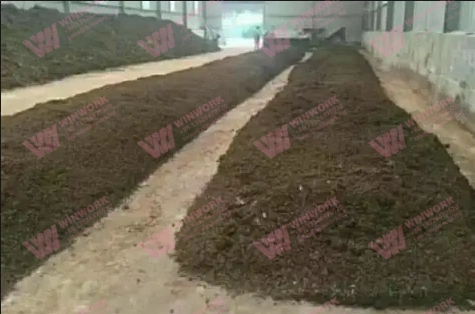
A manure compost turner provides a practical way to manage these problems during windrow composting. By turning and mixing the manure regularly, the equipment helps loosen compacted material, improve contact with air, and distribute moisture and heat more evenly throughout the windrow.
For farms and fertilizer plants that need to process manure on a regular basis, choosing the right compost turner is important. A suitable manure compost turner can help improve the efficiency and consistency of the entire composting operation.This article focuses on two common equipment options: the Crawler Compost Turner and the Wheeled Type Compost Turner. Both can be used for manure composting, while their traveling systems make them suitable for different working conditions.
How a Compost Turner Handles Manure
The purpose of turning is not simply to move a pile from one place to another. A manure compost turner is designed to repeatedly turn and mix the windrow so that the material can maintain more suitable conditions during composting.During composting, manure needs suitable oxygen, moisture, and temperature conditions for microorganisms to break down organic matter. A manure compost turner helps maintain these conditions through mechanical turning and mixing.
Turning and Mixing
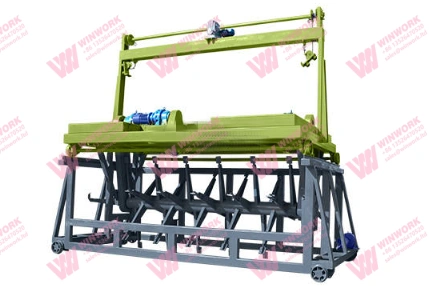
Manure can become compacted after being piled for a period of time, especially when its moisture content is relatively high.A manure compost turner lifts and turns the material while mixing different parts of the windrow. Material from the lower and inner sections can be brought toward the upper surface, while drier and wetter areas are mixed together.
This repeated mixing creates a more uniform composting environment and reduces the formation of heavily compacted areas inside the windrow.
Improving Aeration
Aerobic composting depends on an adequate supply of oxygen. When manure is densely packed, air cannot move easily through the material. Turning loosens the windrow and creates spaces between particles, allowing more air to enter.This is one of the key reasons why a manure compost turner is commonly used in large-scale manure composting.
Regular operation of a manure compost turner can therefore support aerobic fermentation and reduce conditions that may slow down the composting process.
Balancing Moisture and Temperature
Moisture and temperature are not always evenly distributed throughout a manure windrow. The inner part may remain warmer and wetter, while the outer surface can become relatively dry.
Turning mixes these different areas and helps redistribute moisture and heat. A manure compost turner helps distribute these differences throughout the windrow, creating a more uniform environment for the composting process.This makes the overall composting environment more consistent and allows a greater proportion of the material to participate effectively in the fermentation process.
Supporting Compost Fermentation
As the manure is turned and exposed to better aeration, microorganisms can continue decomposing organic matter under more suitable conditions. With repeated turning and appropriate moisture management, the raw manure gradually becomes more stable and mature compost.
Therefore, the role of a manure compost turner is closely connected with the preparation of manure for later agricultural or fertilizer applications.
Crawler Compost Turner for Large-Scale Manure Composting
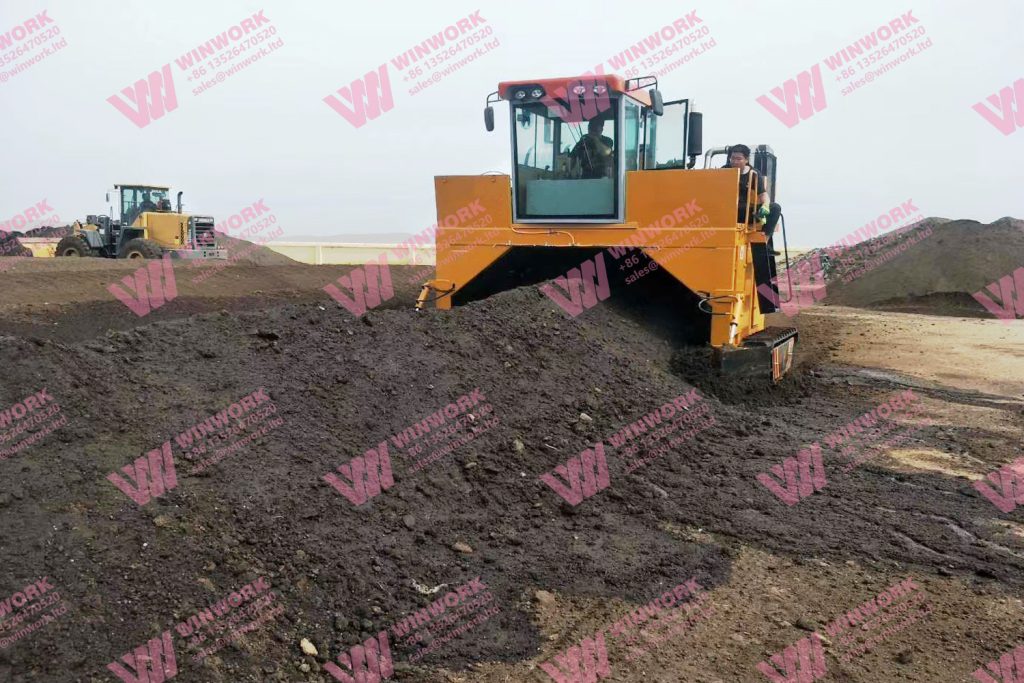
The Crawler Compost Turner is designed for continuous operation along composting windrows.For large manure composting projects, a manure compost turner with a crawler traveling system can provide stable and continuous turning performance.
For example, a cattle farm may generate a large quantity of manure every day. After the manure is mixed with suitable bulking materials such as straw when necessary, it can be arranged into long windrows. The Crawler Compost Turner then moves along the windrow, turning and mixing the material during the fermentation period.
One of the main advantages of this type of equipment is its suitability for continuous windrow operation. When a manure compost turner works along a long windrow, the manure can be repeatedly turned and mixed without requiring manual movement of the material.
The Crawler Compost Turner can also process other biodegradable materials, including agricultural residues and straw, when their physical properties are suitable for the equipment. However, manure remains one of its important applications in organic waste composting.
Wheeled Type Compost Turner for Flexible Manure Processing
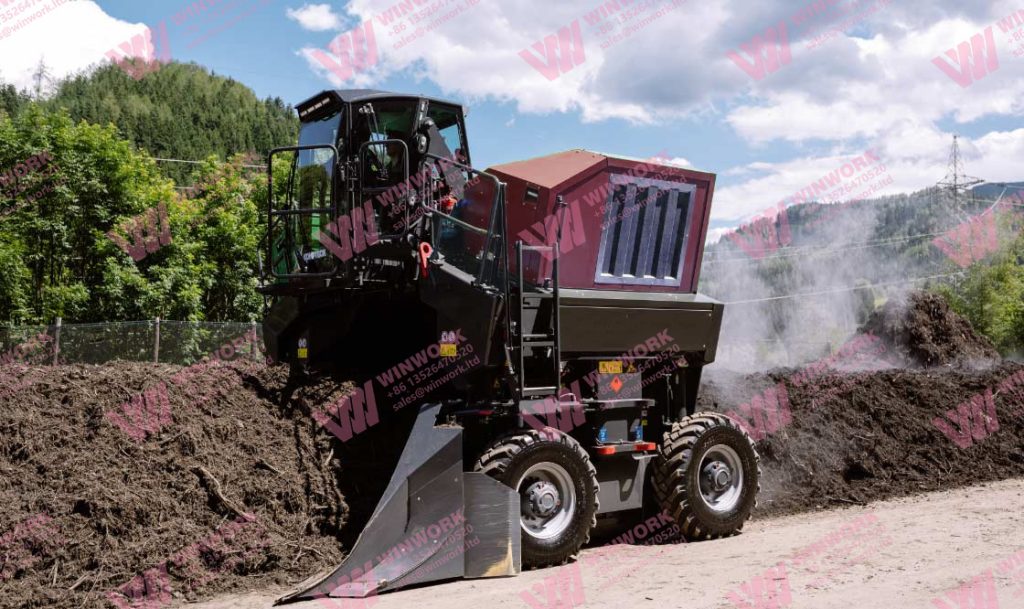
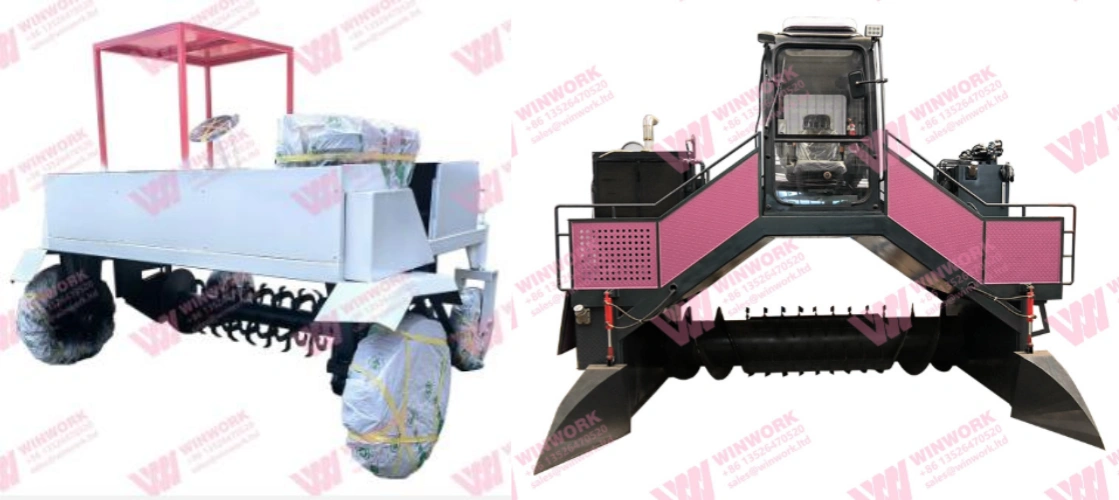
The Wheeled Type Compost Turner uses a wheeled traveling system and is designed for flexible movement around the composting area. For manure composting facilities with several working areas, a wheeled manure compost turner can make it easier to move between different windrows.
For instance, a farm may have several manure windrows located in different parts of the composting site. Instead of processing only one fixed area, a Wheeled Type Compost Turner can move between these windrows and perform turning operations according to the composting schedule.
This flexibility can be useful when the layout of the composting site changes or when manure from different livestock areas needs to be processed separately. The manure compost turner can be moved according to the location and composting schedule of the manure windrows.
In addition to manure, the Wheeled Type Compost Turner can also handle certain agricultural residues and other biodegradable organic waste when the material conditions are appropriate. Nevertheless, its main role in this application is to provide flexible turning for manure composting.
Crawler or Wheeled Type Compost Turner: Which Fits Your Manure Composting Site?
Both machines can be used for manure composting, but their traveling systems and typical working conditions are different. When choosing a manure compost turner, users should compare the site layout, manure volume, windrow dimensions, and required working frequency. Instead of selecting equipment only by name, users should consider the layout of the composting site, the amount of manure to be processed, and how frequently the machine needs to move between windrows.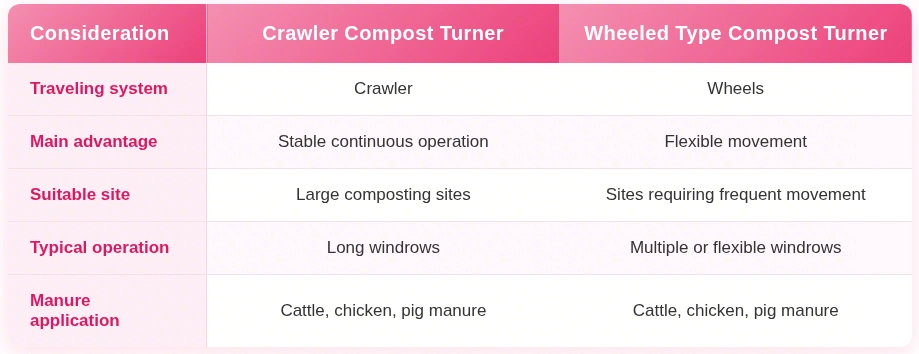
For a project focused on large-scale and continuous windrow composting, the Crawler Compost Turner can be considered according to the site conditions and processing requirements. For a project where the machine needs to move frequently between different windrows or working areas, the Wheeled Type Compost Turner can provide greater mobility.
The final choice should be based on actual material conditions and project requirements rather than simply choosing one machine for every manure composting application.
From Manure Composting to Organic Fertilizer Production
Manure composting is often only the first stage of a larger organic fertilizer production process. After the manure has been sufficiently fermented and matured, the composted material can be further processed depending on the final product requirements.
A typical process may include:
Manure → Mixing → Windrow Composting → Turning → Fermentation → Crushing→ Granulation →Screening → Packaging
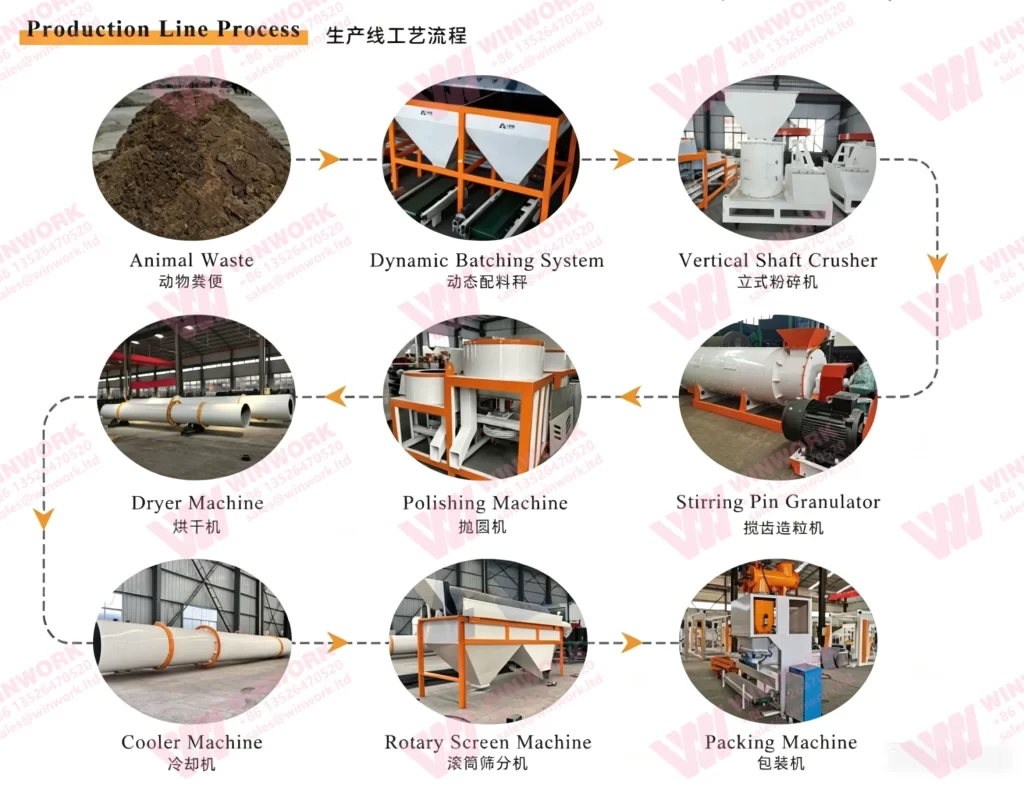
The first stage focuses on preparing the raw manure and adjusting its physical conditions for composting. During windrow composting, the compost turner regularly turns the material to maintain suitable conditions for fermentation.
After the compost becomes sufficiently mature, it can be crushed and screened to improve particle uniformity. If the final product is granular organic fertilizer, the processed material can then enter a granulation system before cooling and packaging.
For customers who want to convert livestock manure into commercial organic fertilizer, an organic fertilizer production line can connect the composting stage with subsequent crushing, screening, granulation, and packaging processes. In this way, the manure is not only treated as waste but also converted into a usable fertilizer resource.
How to Choose a Manure Compost Turner for Your Project
The appropriate equipment depends on several basic project parameters. Before selecting a manure compost turner, customers should provide clear information about the material and working conditions.
Manure Type
Different materials, such as cattle manure, chicken manure, and pig manure, may have different moisture levels, structures, and physical properties. The type of manure should therefore be considered during equipment selection.
Moisture Content
Moisture affects the physical condition of manure during composting. Very wet material may become sticky and compacted, while material that is too dry may not provide suitable conditions for biological fermentation. The actual moisture content should be considered when designing the composting process.
Processing Capacity
The required capacity is another important factor. Customers should estimate how much manure needs to be processed per day or per hour. This information helps determine the appropriate machine size and working arrangement.
Windrow Size
The width and height of the composting windrow should match the working dimensions of the selected equipment. Proper matching allows the machine to turn the material effectively without leaving untreated areas.
Composting Site
The size and ground conditions of the composting site also influence equipment selection. If the project requires frequent movement between different windrows, the mobility of the machine becomes more important. For large sites with long, fixed windrows, continuous operation may be a higher priority.
By considering manure type, moisture content, processing capacity, windrow size, and site conditions together, customers can select a suitable Crawler Compost Turner or Wheeled Type Compost Turner for their project.
Conclusion
Efficient manure composting requires more than simply piling animal waste. Proper turning helps improve mixing, aeration, moisture distribution, and temperature uniformity during the fermentation process. For farms and fertilizer producers handling livestock manure, both Crawler Compost Turners and Wheeled Type Compost Turners can provide practical solutions under different site conditions.
The Crawler type is suitable for stable, continuous operation along larger windrows, while the Wheeled type provides greater flexibility when movement between different working areas is required. After fermentation, the mature compost can also be further processed into commercial organic fertilizer.
Selecting the right manure compost turner according to manure type, processing capacity, windrow size, and site conditions can help create a more efficient composting process and prepare the material for further fertilizer production.

Get A Quote