

Introduction
Producing uniform fertilizer granules from powdery raw materials is an important part of modern fertilizer processing. Granules are generally easier to handle, transport, store, and apply than loose powder. However, different granulation methods require different amounts of water, heat, energy, and processing equipment.
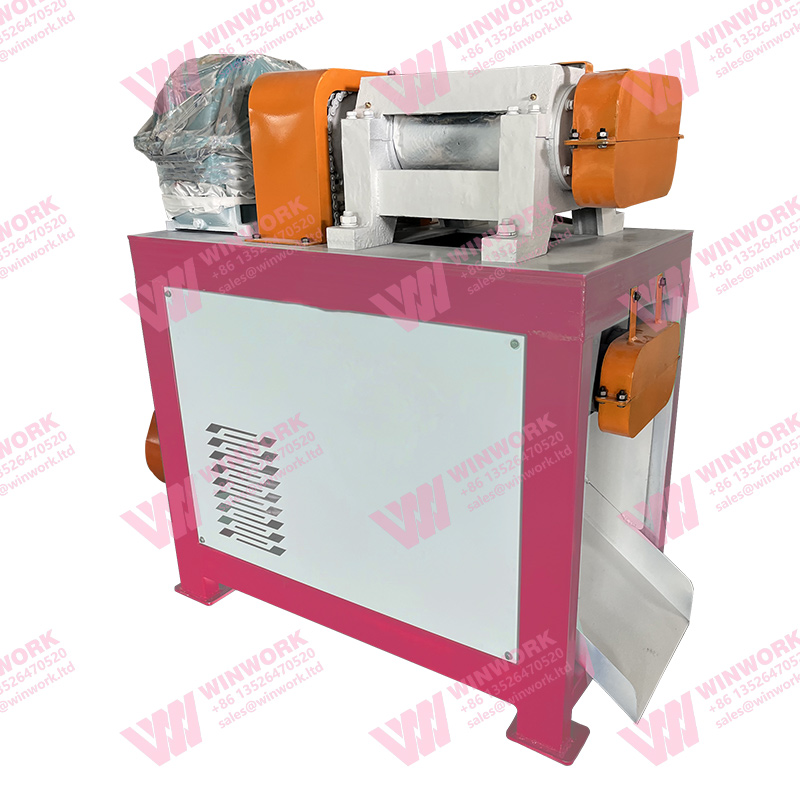
For fertilizer producers working with suitable dry or low-moisture materials, mechanical compaction provides another approach. A roller press granulator uses pressure between two rotating rollers to compact powder into dense sheets or flakes, which are then crushed and screened into granules.
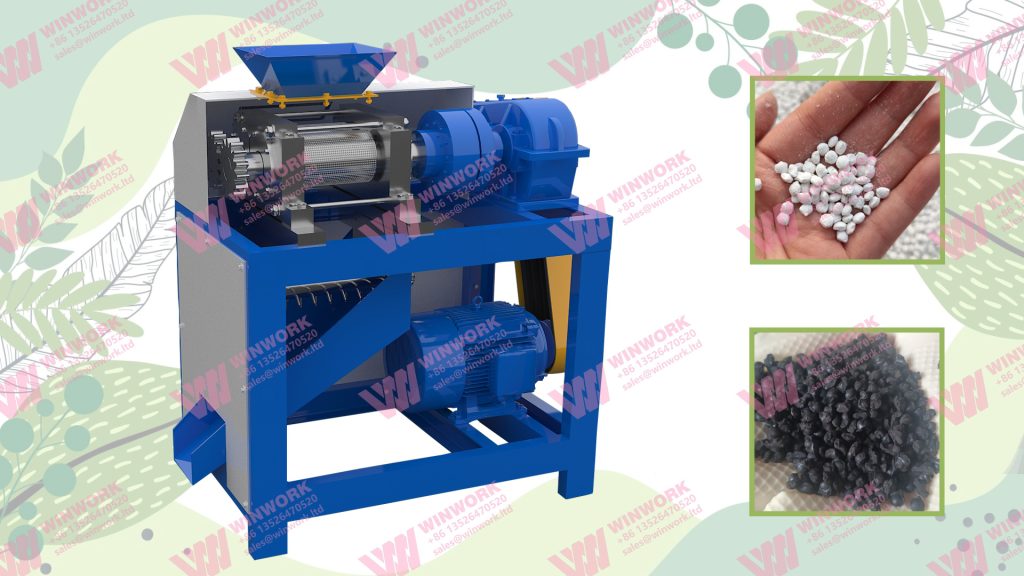
Roller Press Granulator
This process is particularly relevant to dry granulation. Instead of relying heavily on liquid addition and subsequent drying, the material is formed primarily through mechanical pressure. Understanding how this process works, where it can be applied, and what factors affect equipment selection can help producers determine whether it fits their fertilizer project.
What Is a Roller Press Granulator?
A roller press granulator is a type of fertilizer granulation equipment that forms granules through mechanical compression. Its main working components are a pair of counter-rotating rollers positioned close to each other.
When powdered fertilizer materials enter the machine, the rotating rollers pull the material into the compression area. Pressure is then applied to compact the powder into sheets, flakes, or other compressed forms. These compacted materials are subsequently processed into smaller particles and screened according to the required granule size.
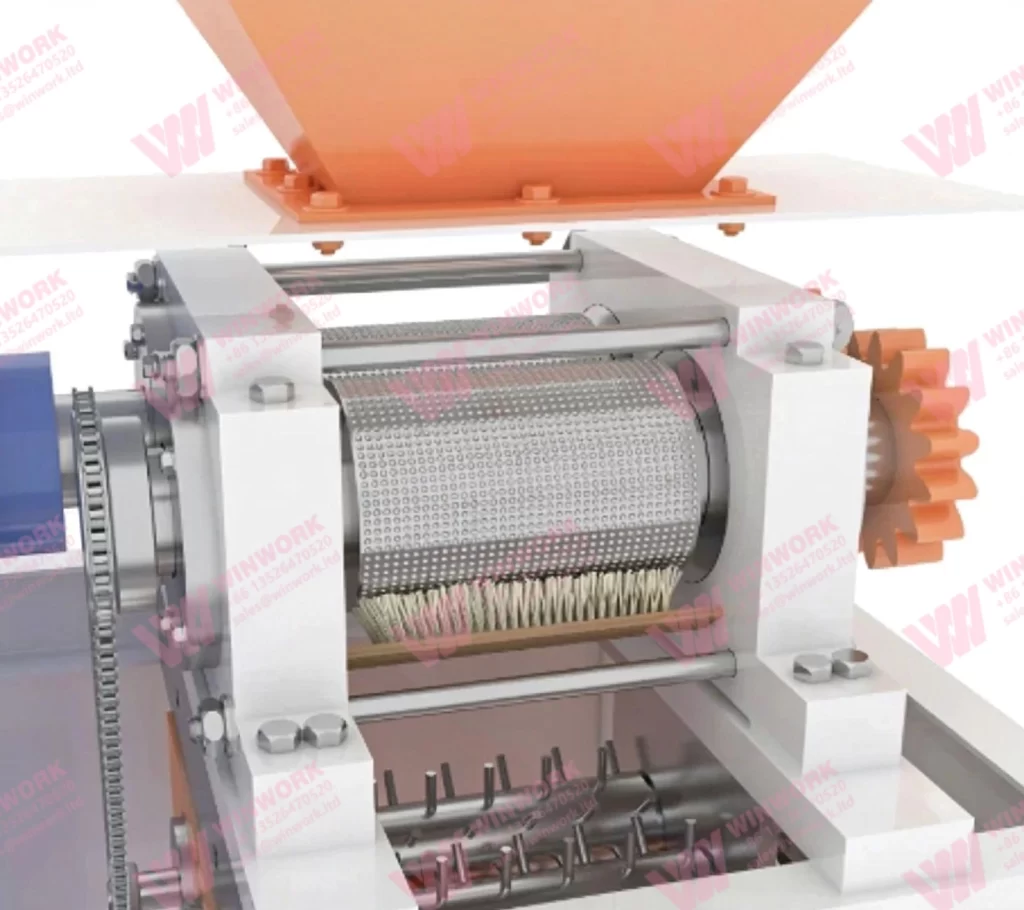
Roller Press Granulator
Unlike some wet granulation systems, the process does not depend on large amounts of liquid to make the particles stick together. The primary forming force comes from mechanical pressure.
The complete process can therefore be understood as:
Powder Feeding → Roller Compression → Flake Formation → Crushing → Screening → Finished Granules
The exact configuration can vary according to the material, capacity, desired granule size, and final product requirements.
A properly designed roller press granulator can be integrated into a fertilizer processing system together with feeding, crushing, screening, conveying, and packaging equipment.
How Does a Roller Press Granulator Work?
The working process of a roller press granulator involves several connected stages. Each stage contributes to the formation of consistent fertilizer particles.
Feeding the Raw Material
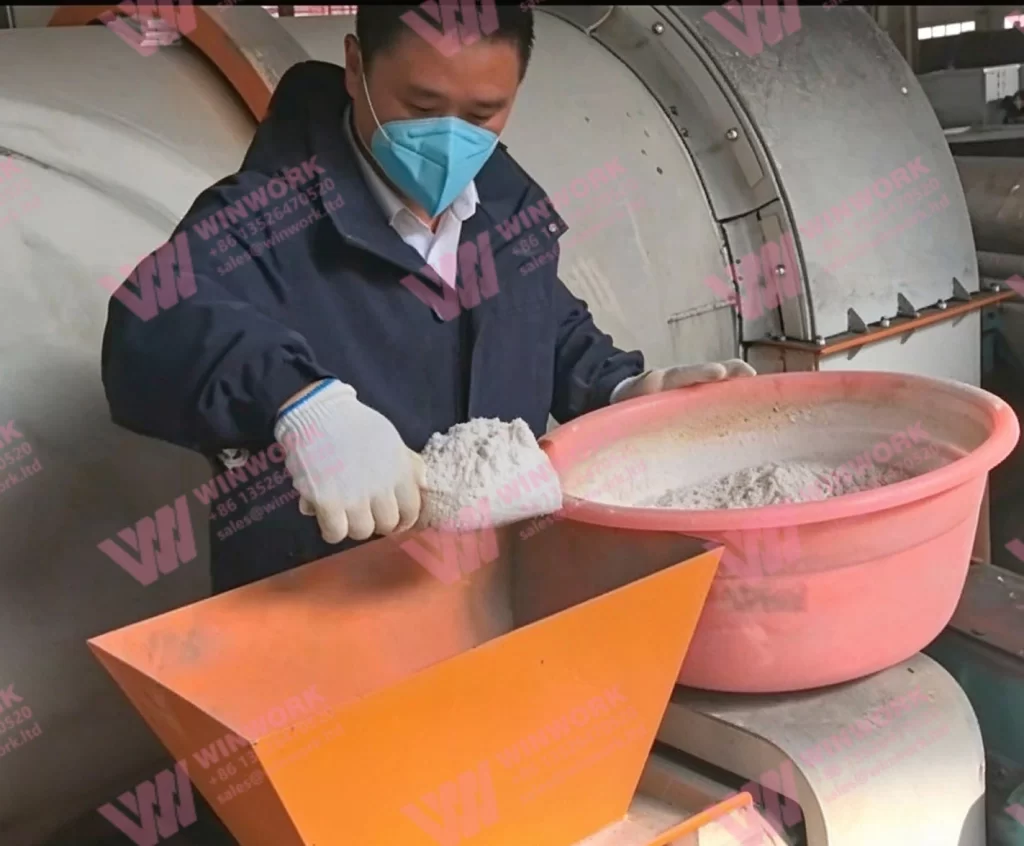
The fertilizer powder first enters the feeding system. Consistent feeding is important because an uneven material flow can affect the pressure distribution between the rollers.
Before granulation, raw materials may need to be crushed, screened, or mixed to achieve a more suitable particle size and composition.
Compression Between the Rollers
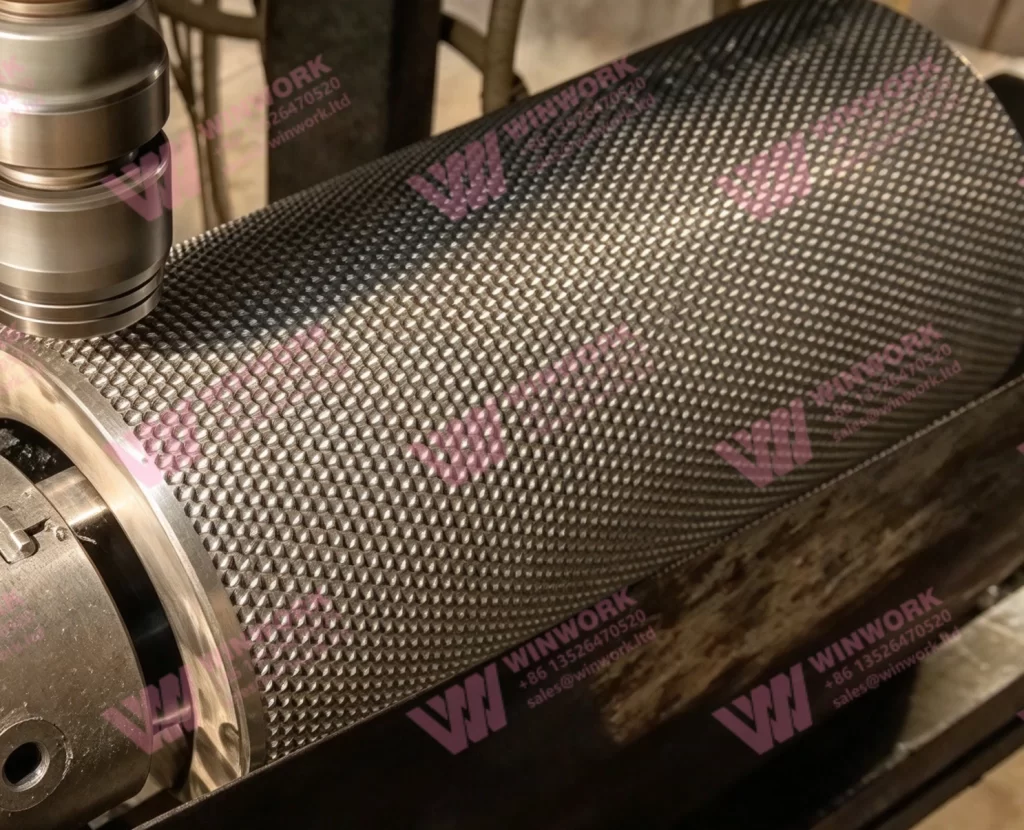
Roller
The prepared powder moves between two rotating rollers. As the rollers rotate, they draw the material into the gap and apply mechanical pressure.
The pressure compacts individual particles and reduces the amount of empty space between them. The material is gradually transformed from loose powder into a denser compressed form.
Flake Formation
Under sufficient pressure, the compacted material leaves the roller area as sheets, flakes, or compressed blocks.
The density and strength of these compacted materials depend on several factors, including the raw material properties, moisture level, formulation, feeding conditions, and applied pressure.
Crushing and Screening
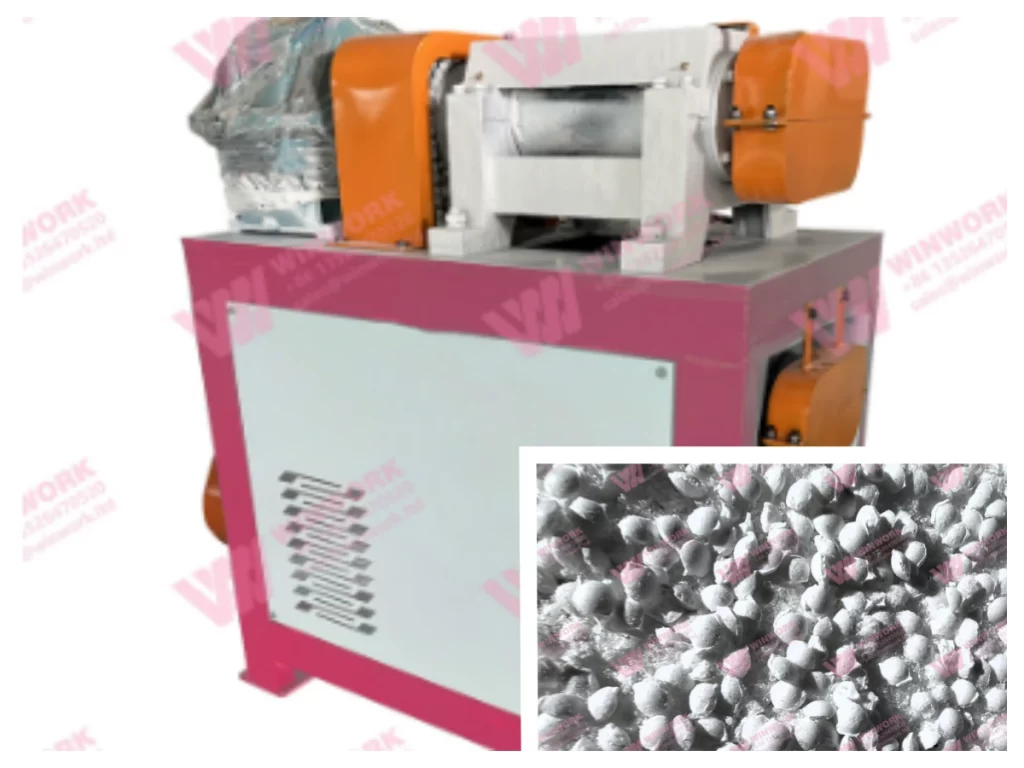
The compressed material is then broken into smaller particles. A screening system separates particles according to the required size.
Oversized particles can be returned to the crushing stage, while undersized material may be recycled into the granulation process. This recycling loop helps improve material utilization and maintain a more consistent finished product.
This means the roller press granulator is only one part of the overall granulation process. Proper material preparation and downstream screening are also important for achieving the desired result.
Dry Granulation: A Key Feature of Roller Press Granulators
One of the most important characteristics of roller press granulation is its ability to produce granules through a dry compaction process.
What Is Dry Granulation?
Dry granulation forms particles primarily through mechanical pressure rather than liquid-assisted agglomeration. Powdered materials are compressed into dense sheets or flakes and then reduced to the required particle size through crushing and screening.
This approach is different from many wet granulation processes, where liquid or binder is introduced to help particles agglomerate. Wet granulation may also require subsequent drying to remove added moisture.
With a roller press granulator, the material can often be processed with little or no additional liquid, depending on the formulation and its physical properties.
Why Does Dry Granulation Matter?
The reduced dependence on liquid addition can simplify the processing route for suitable raw materials.
Depending on the material and overall process configuration, dry granulation can:
- Reduce the need for additional water during granulation
- Reduce or avoid a conventional post-granulation drying stage
- Lower the dependence on drying equipment
- Create a relatively compact production process
- Reduce the number of moisture-related processing steps
- Provide an alternative for materials that are suitable for mechanical compaction
However, dry granulation should not be viewed as a universal solution for every fertilizer material. The raw material must have suitable physical properties for compaction.
For example, moisture content, particle size, density, compressibility, formulation, and required granule strength can all affect the performance of the process.
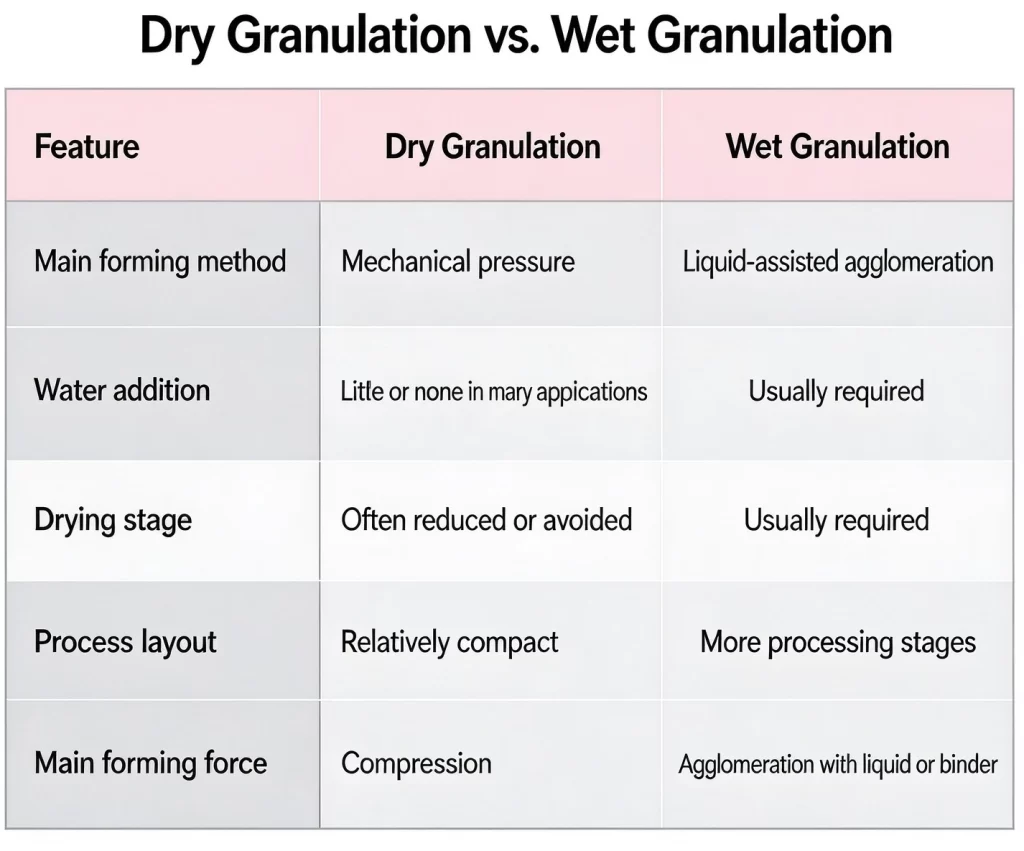
The main value of a roller press granulator in this context is therefore not simply that it produces fertilizer granules. Its mechanical compaction method provides an alternative granulation route when the raw material and product requirements are suitable.
Applications of Roller Press Granulators in Fertilizer Production
Roller press granulation can be used for various fertilizer materials, particularly powdery raw materials that have suitable compaction characteristics.
NPK and Compound Fertilizers
NPK fertilizers contain nitrogen, phosphorus, and potassium sources in different formulations. Depending on the formulation and physical characteristics of the raw materials, dry compaction can be considered as one possible granulation method.
For compound fertilizer production, operators should evaluate the formulation, moisture level, particle size, compressibility, and required granule strength before selecting equipment.
Ammonium Sulfate and Potassium-Based Fertilizers
Ammonium sulfate and potassium-based fertilizer materials can also be considered for roller compaction when their physical properties are suitable.
The actual granulation performance depends on the material rather than simply its chemical name. Laboratory testing or production trials can be useful when working with unfamiliar formulations.
Other Powder Fertilizer Materials
In addition to common fertilizer formulations, certain mineral fertilizer powders and blended fertilizer materials may be suitable for dry compaction.
The important consideration is whether the powder can be effectively compressed and subsequently processed into granules with the required size and strength.
Therefore, a roller press granulator should be selected based on both the material and the intended finished product rather than using the same configuration for every application.
Benefits and Selection Considerations
The advantages of a roller press granulator are closely related to its mechanical compaction method.
Main Benefits
The dry granulation process can provide several practical advantages for suitable fertilizer materials.
First, it can reduce the need for liquid addition during granulation. This can also reduce the need for downstream drying in processes where no significant moisture is introduced.
Second, the equipment can form compacted material through continuous mechanical pressure, making it suitable for continuous fertilizer processing systems.
Third, the overall process can be relatively compact because fewer moisture-removal stages may be required.
Another benefit is its potential integration with other fertilizer processing equipment. Crushing, mixing, screening, conveying, and packaging systems can be arranged around the granulation stage according to the project requirements.
What Should You Consider Before Selection?
Selecting a roller press granulator should begin with the characteristics of the material rather than the machine model alone.
Important factors include:
- Processing capacity: Determine the required output in kg/h or t/h.
- Raw material moisture: Excessive moisture may affect compaction and material flow.(The moisture content of the general raw materials should be below 15%.)
- Particle size: Consistent feed size can contribute to stable operation.
- Compressibility: The powder needs suitable compaction characteristics.
- Granule size: The required finished particle size affects the crushing and screening configuration.
- Granule strength: Product requirements can influence the compaction conditions.
- Production layout: Consider how the granulator will connect with upstream and downstream equipment.
For projects with unfamiliar raw materials, testing the material before final equipment selection can help determine whether the proposed process can achieve the required granule quality.
Roller Press Granulator in a Complete Fertilizer Production Line
A roller press granulator does not necessarily operate as an isolated machine. In commercial fertilizer production, it can be integrated into a complete processing system.
A typical process may include:
Raw Material Preparation → Crushing → Mixing → Roller Press Granulation → Crushing → Screening → Recycling → Packaging
The first stages prepare the fertilizer materials for stable feeding and compaction. Mixing ensures that different components are distributed throughout the formulation.
The granulation stage then uses mechanical pressure to compact the prepared powder. After compression, the material is crushed and screened to obtain the desired particle size.
The screening stage is particularly important because not every particle leaving the crushing system will have the required dimensions. Oversized and undersized materials can be returned to the appropriate processing stage.
Finally, qualified granules can be conveyed to packaging equipment for storage and transportation.
For a larger fertilizer project, the granulation section can also be connected with a complete fertilizer production line, allowing raw material preparation, granulation, screening, recycling, and packaging to operate as an integrated system.
The appropriate configuration depends on the raw materials, production capacity, final granule specifications, available space, and level of automation required.
Final Thoughts
A roller press granulator provides a mechanical approach to fertilizer granulation by using pressure to compact powder into flakes and subsequently processing them into finished granules.
One of its most important characteristics is dry granulation. For suitable materials, this process can reduce the need for liquid addition and may reduce or avoid the conventional drying stage associated with wet granulation.
Its applications can include NPK fertilizers, compound fertilizers, ammonium sulfate, potassium-based fertilizers, and other suitable powder materials. However, material properties and product requirements should always be evaluated before selecting equipment.
For fertilizer producers looking for a practical dry granulation solution, a properly configured roller press granulator can become an important part of an integrated fertilizer processing system.

Get A Quote